
Warning: Incoming pretty graphs to explain some numbers.
It is a foregone conclusion that at the next Bradford Executive meeting on 8th September, the much-campaigned-for reopening of the Sugden End Household Waste Recycling (HWRC) tip will be waved through. It makes for a great headline and the local Conservatives are already crowing over what they see as a victory. That is, until you realise that it won’t solve Bradford’s chronic flytipping problem and that it is being funded by cancelling an Events pot designed to encourage inward investment and trade.
A campaign that hit the spot
There can be no denying the effective advocacy of local Conservative councillors alongside Keighley and Ilkley’s ever-online MP Robbie Moore. A set of government-sourced data gave Moore and Co the ammunition to declare Bradford a Yorkshire fly-tipping mecca, which the Council mismanaged by wasting on vanity projects (like the Events fund?) The relative inconvenience of some residents having to make a 22-mile round trip is real, as are long queues at busy times at the remaining HWRC sites. As for the rest? It’s politics.
Here’s the thing. The DEFRA source data used by advocates doesn’t bear comparison with Bradford Council figures. So what if Moore & Co have pulled off a fabulous political victory but achieved little to no result? At best, the ‘facts’ are debatable. More problematic is the framing.
The numbers are inconsistent. A big part of Moore & Co’s argument rested on huge figures it got from DEFRA. In its own reporting, Bradford Council uses different figures for broadly the same things. This chart explains the disparity.
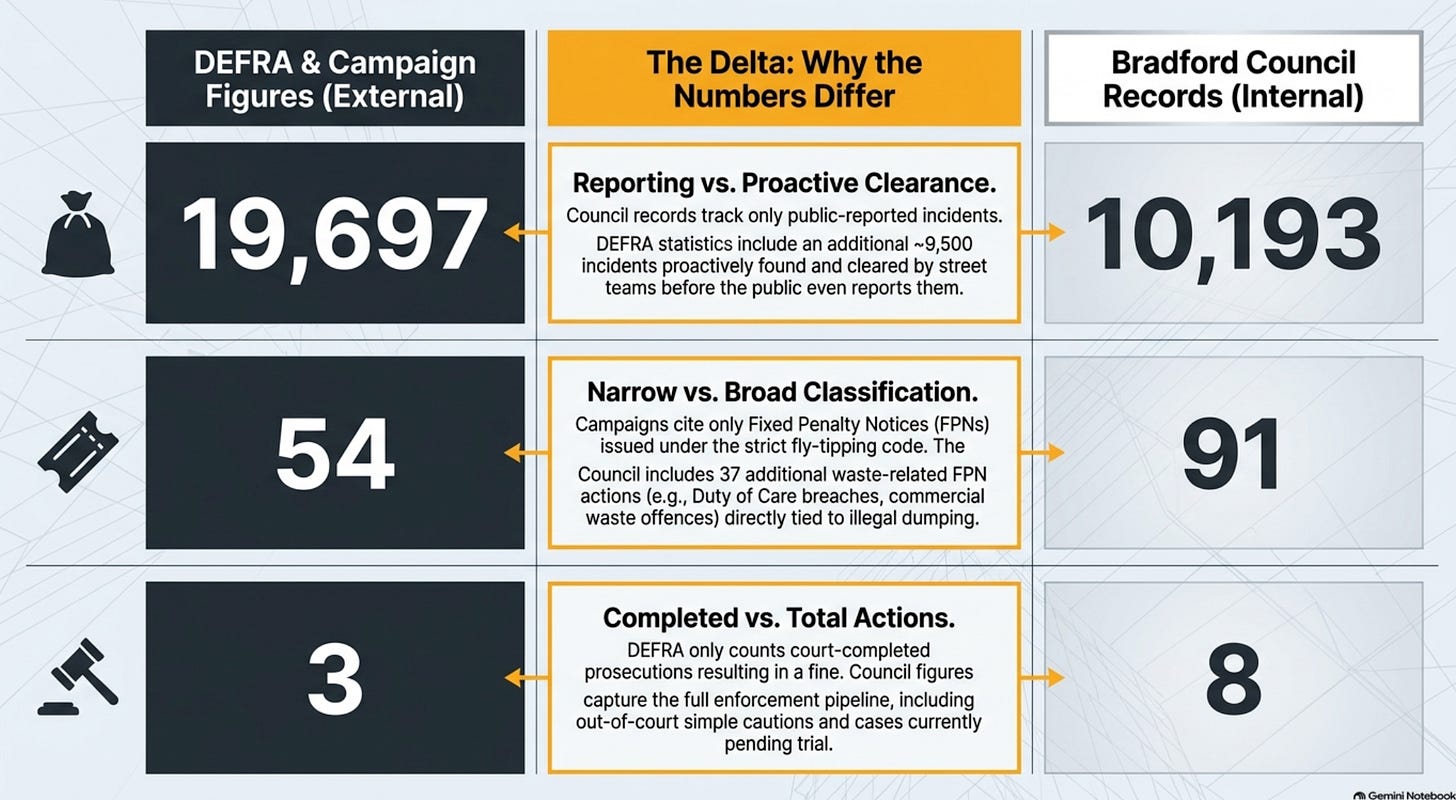
You can write most of this off to politicking, but it begs more questions. The Council’s preference for focusing upon publicly reported cases is all well and good. But surely adding it's own sourced data helps the public understand that tackling flytipping is proactive, not just something the Council addresses when it receives complaints. And that’s just the start?
What is flytipping like in Worth Valley? Here is another wee illustration. It clearly shows a massive jump in reported incidents after the tip closed that has only recently moderated somewhat.
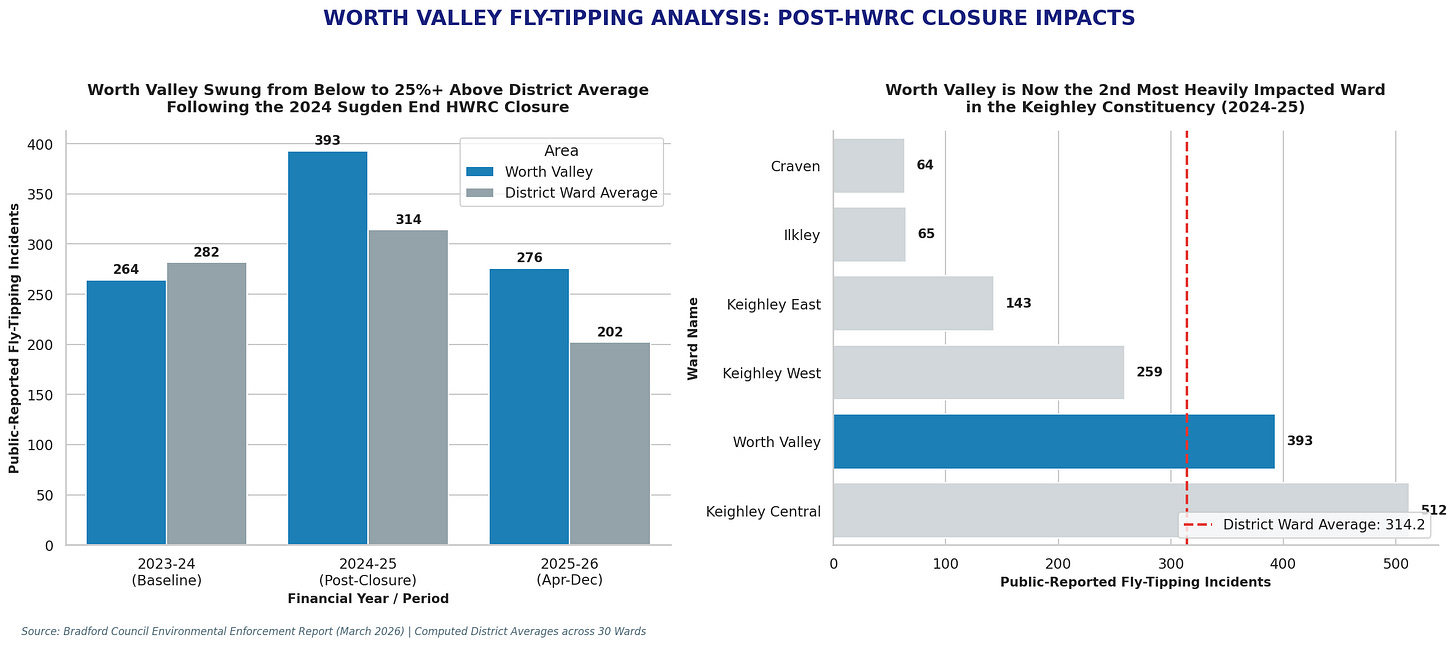
But, compared to the average of all wards? Yes, it has got worse, but the numbers reported are relatively small. Now compare that with Little Horton, the worst ward for reported flytipping.
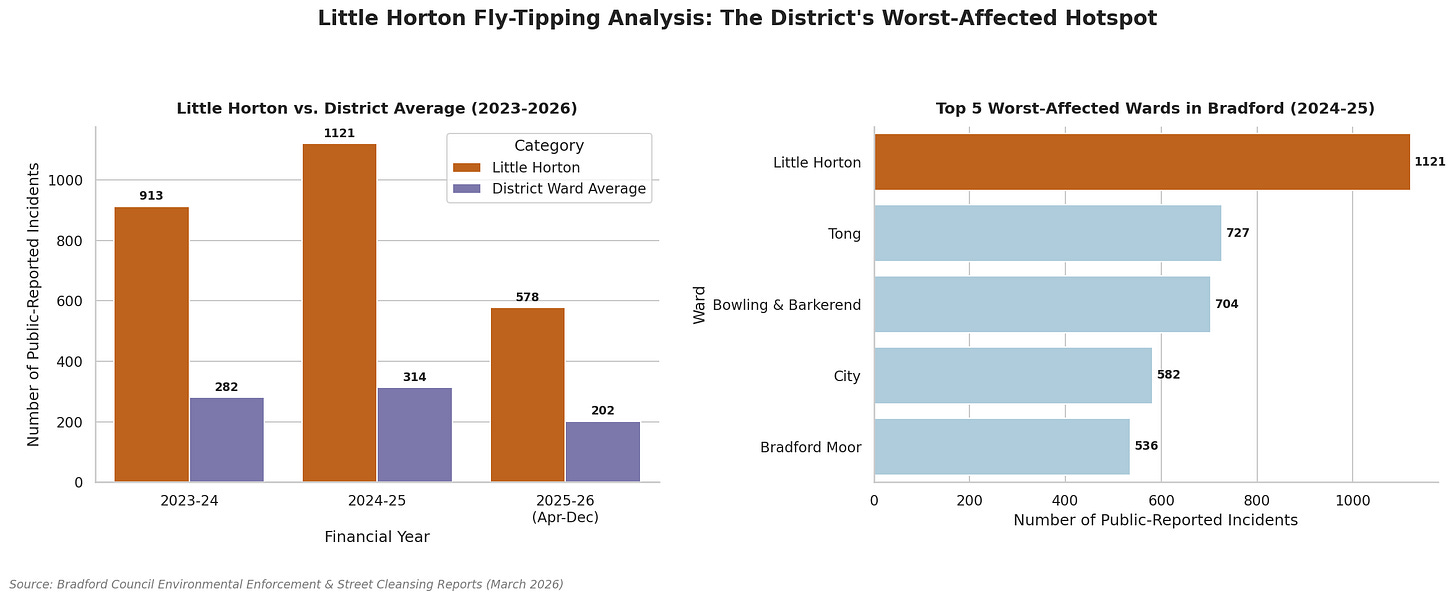
These numbers are horrendous, yet they are part of the same overall figures used by the Moore & Co campaign. In short, their argument was skewed by data from other wards that you cannot realistically compare and which massively skews the way in which the case is presented. It also infers that while the good people of Worth Valley and surrounding areas will undoubtedly benefit, the impact on the council’s outturn will be modest at best and almost invisible at worst. In fact, successive portfolio holders in the last and this administration contend that the closure of HWRC sites has no bearing on the flytipping data.
So what is it about Little Horton and the other inner-city areas shown above that leaves them as the big bad wards? In a March 2026 report, the Council says that the large number of unadopted alleys with no statutory cleaning duty, HMO bin shortages, and “man-and-van” operators dodging weighbridge fees all fit into this equation. Taken at face value, the data says access isn’t the problem, but enforcement and land ownership are.
My Take
How can those issues be tackled? Flytipping is understandably a sensitive topic, but there are no quick fixes or easy solutions. A cursory study of waste management tells me that the expression ‘It’s complicated’ doesn’t come close to describing a topic that has all the downside qualities of playing Whack-a-Mole and few of the benefits an essential service delivers.
Each item in this complex web of contradictions and traps provides an opportunity to explore solutions, but where to start? The Council papers demonstrate a history of trying various strategies to reduce flytipping. But they frequently end up tackling the problem from the wrong end. If the infrastructure where you’re working is poor, no amount of community effort will make a sustainable difference. A more radical approach is necessary.
Who will lead that? Now is the time for the inner-city ward councillors to posit actionable suggestions. They know their communities; they know it’s a problem; they should know their residents’ needs.
In the meantime, two things are clear. The Bradford Conservatives are now in hock to the minority Reform-led administration. That debt will come due around budget time. The irony of nuking a budget designed to promote growth and business is not lost on me. I wonder if it bypassed Council Leader Stephen Place, who has repeatedly said that growth and business are at the heart of his strategy.