
Bradford Council wants £50m of savings in 2027-28. About £1.2m of it comes from digitisation. At the Executive on 3 November, Cllr Raph Cohn said the digitisation savings he could find "seem very modest indeed."
Cohn asked about the bounds and questioned whether one line was a saving at all. He asked to see the outline business cases. There was no commitment to share them.
Bradford's modest ambitions
Cohn found two digitisation lines: about £230,000 in adult social care, and about £950,000 in the Children's Trust. Together that's roughly £1.18m, or 2.4% of the total budget savings plan.
He said he couldn't see the follow-on savings digitisation should bring. He also said the savings come with no bounds or confidence intervals, so members can't judge whether they'll land.
Steven Mair, the council's chief finance and s151 officer, said that digitisation is "the start of a longer journey," with proposals to follow. He gave nothing else away. For reference, this isn't the first time digital has been the next big thing:
- 2025-26: the Council proposed saving £1.6m by transforming customer services and contract management with voice automation, robotic automation and other digital technology.
- 2026-27: the savings report included moving meetings to digital minute-taking, with governance and safety measures for the AI still to be put in place.
- 2027-28: £1.18m, and a longer journey.
What did the £1.6m deliver? I haven't found a published answer.
The £200k saving is an accounting entry.
The Budget proposal moves £0.20m of staff costs from the revenue budget to capital. Cohn said it didn't look like a saving but an accounting treatment and asked for clarification.
Mair confirmed the mechanics. After a review, more staff time can be appropriately charged to capital works: "we can charge a little more," which helps the revenue budget.
The Council's own share of its capital programme is largely funded by borrowing. Where these schemes are borrowing-funded, the £200k doesn't disappear. It moves onto the loan book, with interest and repayment charges attached.
The schemes and how they're funded were left unsaid.
The North Yorkshire AI showcase
If Bradford wants a model, North Yorkshire is the obvious choice. Ofsted rated its children's services Outstanding. Its AI case-management pilot has won national awards, and its own scrutiny report says Microsoft called the work "cutting edge."I asked North Yorkshire to detail the pilot's costs. The total spent was a tad over half a million pounds, all coming from a DfE Data and Digital Solutions Fund grant. Most of that spend went to staff; just under 10 per cent went to technology. Experience tells me that is not an unusual project cost mix.
I would have liked more detail, but the project documents are not available. Yet a February 2023 grant acceptance report sits on the council's own website. I also asked about two other AI tools, Policy Buddy and Magic Notes. The response didn't mention either.
The LGA case study on the pilot lists one benefit worth savouring: historical case data stays accessible when the original staff member no longer works for the council. Its headline efficiency claim is a 90% cut in time and cost for "some data retrieval tasks." The council's December 2025 scrutiny report says Magic Notes users reported saving up to a day a week. Its financial implications section reads "Not applicable." Most likely, they've used the savings to fund improved frontline services.
AI anyone?
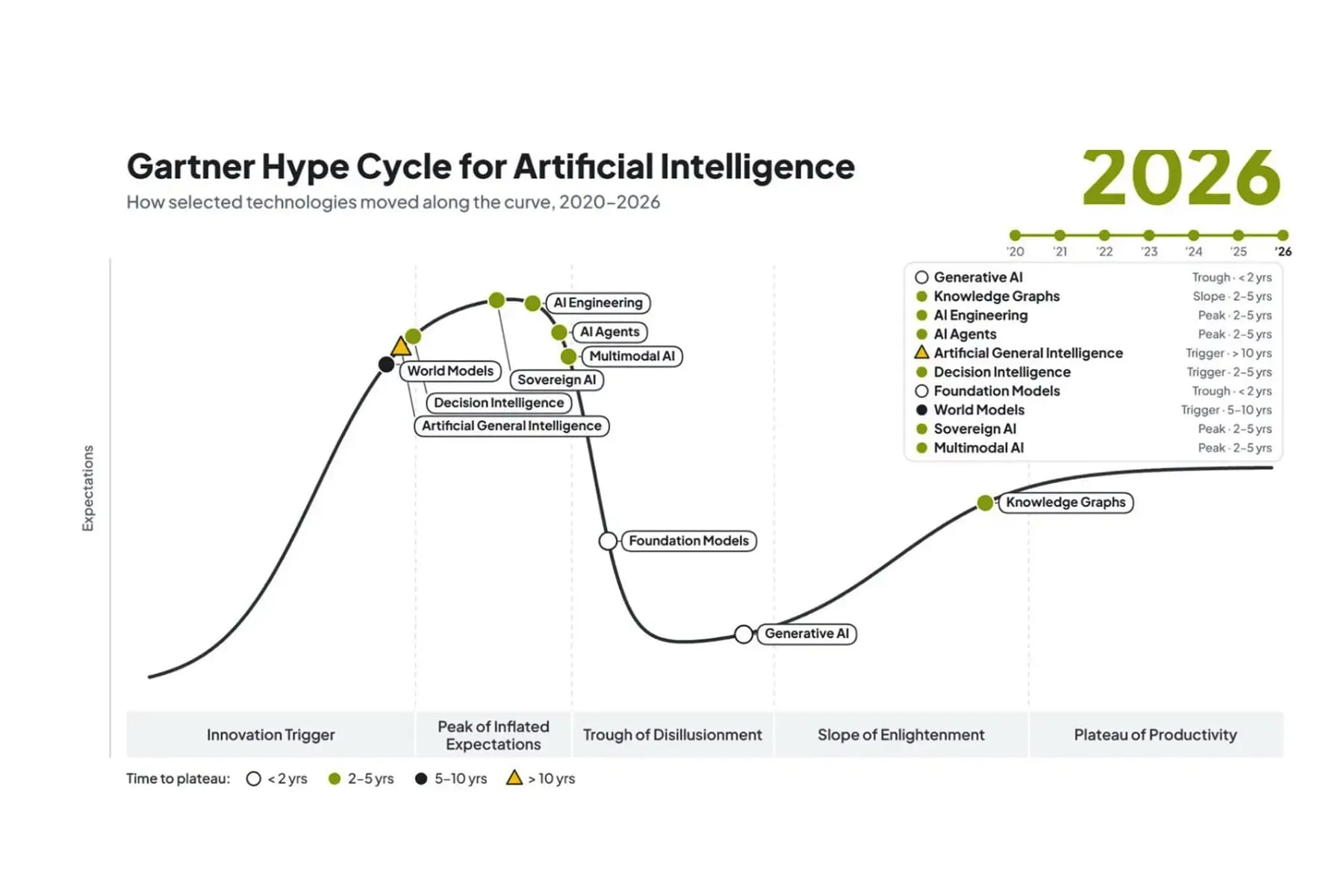
While AI is the tech flavour of the month, easily tripping off national politicians' lips, much of what we've seen so far follows the infamous Gartner Hype Cycle. The Gartner Hype Cycle graphically charts how public excitement, expectations, and market adoption for a new technology rise and fall over time.
Right now, the hype cycle suggests we're heading into the Trough of Disillusionment, where interest in a new technology wanes because early experiments and implementations fail to meet overhyped expectations.
Bradford's publicly revealed ambition is modest. £1.18m of digitisation savings in a £50m plan doesn't pretend to be a revolution. But then the one line that sounds technical, the £200k, is a book-entry move.
North Yorkshire is the tighter lesson. It is the council everyone points to. It can't put its hand on the business case, but its best evidence is a 90% saving on some tasks and staff saying they saved up to a day a week. That isn't a return on investment, and while it clearly drives efficiency, AI can do far more.
The potential for business transformation is enormous. However, the relatively glacial pace of public-sector operations makes achieving transformational value unlikely anytime soon.
My Take
Mair's reference to a 'longer journey' is a teasing understatement. The council is committed to a significant core SAP systems upgrade, with the last budget item in the £8 million ballpark. As a former SAP Mentor, I have a specific view on these matters, which, in this case, sums up to 'good luck with that.' Does this controbute part of the savings? We don't know.
We also don't know whether AI is seen as a series of systems-adjacent technologies or as a strategic topic, alongside the SAP upgrade. If so, the council will need stringent due diligence and specialist lawyers to protect itself and ensure project delivery.
When Bradford says digitisation is the start of a longer journey, members are entitled to ask where it's going, what it costs to get there, and how long it will take to reach the finishing line. Cllr Cohn addressed some of these matters but got scant answers. Corporate Overview and Scrutiny meets on 12 November. It should ask again.
Declaration of interest: I am invested in several AI-oriented startups. AI has been on my radar for more than 30 years. I use custom AI tools extensively for research and document management.