
Bradford Council's financial history almost always sparks heated debate. Today was no exception, with Reform and Labour councillors trading versions of history that, on their face, can never be reconciled. As expected, Bradford's Executive approved £46.42m of savings for 2027-28 on 3 November 2026. The more revealing exchange concerned how the council arrived at that figure.
Cllr Ian Eglin, Reform's Executive member presenting the savings, said the council had been underfunded for a long time but, "due to probably not watching" closely, it "all came to a head in 23-24". It "should have been managed better."
Cllr Imran Khan, Labour group leader, pushed back. The problem started in 2010-11 with austerity, he said: by 2015 the council "had to stop doing things", with £350m a year taken out over time. Labour's last three years of work, supported by a strong chief finance (S151) officer, led to the council leaving emergency support early.
Both are partly right. Neither tells the whole story. What follows pieces it together from the council's own budget and outturn reports, the government's funding data, the commissioner's report on children's services, the auditors and Parliament's record.
Cut harder than everyone else? Not since 2015
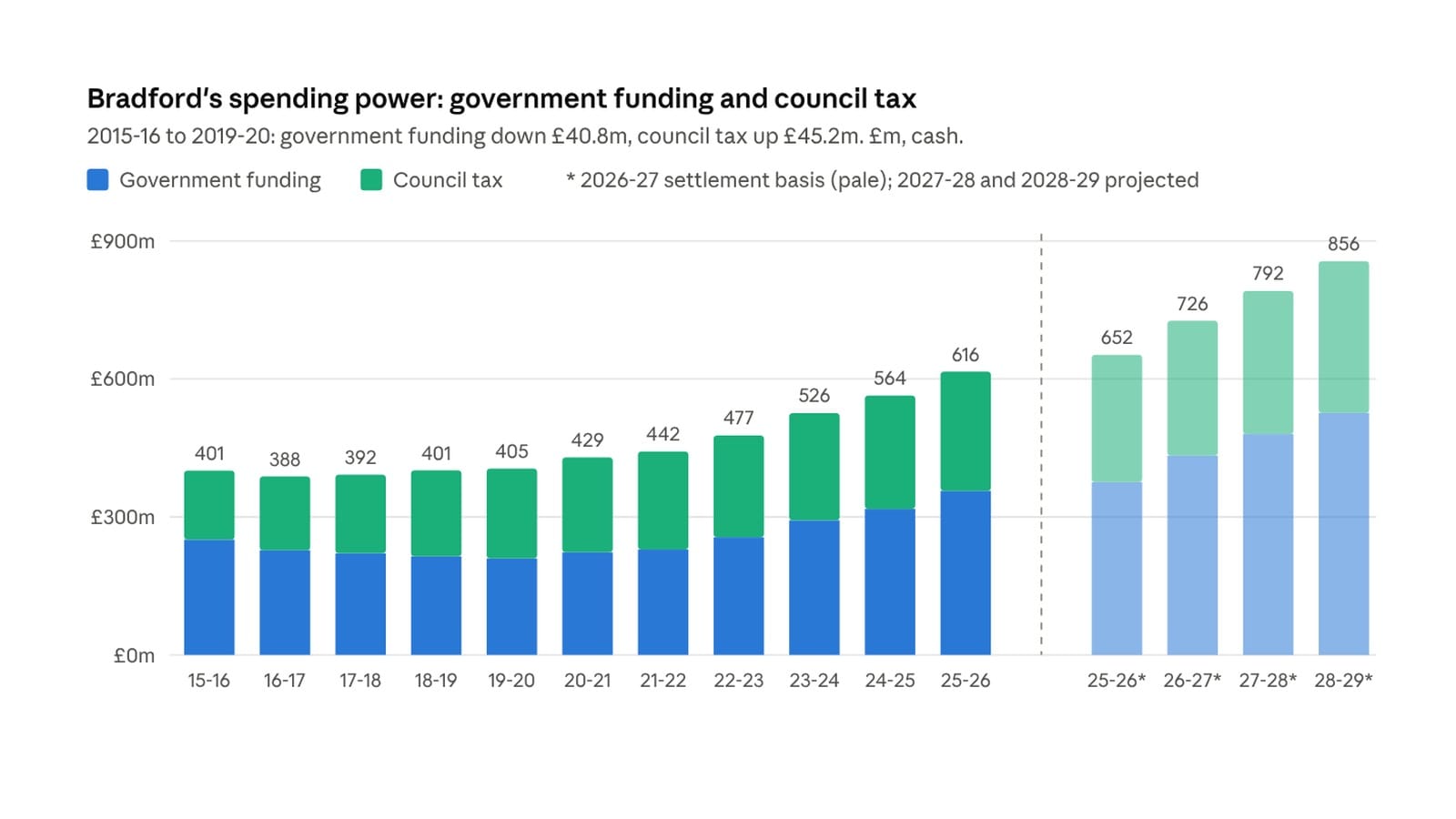
Bradford is underfunded relative to need. That part of Labour's case holds and represents a long-running sore. The council depends heavily on government grants: in 2015-16, council tax was 37% of its spending power, compared with 49% in England. Grant cuts therefore bite harder here, and each 1% on council tax raises less. Revenue Support Grant fell from £183m in 2013-14 to nil by 2019-20, though the nil partly reflects a business rates pilot.
The council's own budget papers say Bradford's funding is about £106m a year below comparable councils, and that its spending power fell 24% in real terms since 2010-11 against 15.9% nationally.
The government's own measure tells a narrower story. On MHCLG's Core Spending Power tables, Bradford's spending power rose 53.7% in cash terms between 2015-16 and 2025-26. England's rose 54.6%. Bradford lagged slightly every year — worth roughly £11m to £16m a year had it kept pace — but nothing like £106m.
The gap between those figures is the difference between being cut and being underfunded. The bigger numbers measure funding against assessed need under a formula frozen since 2013-14, and include the deepest cuts of 2010-15, which the government series does not cover. Both are legitimate grievances.
Since 2015, local taxpayers have carried the load. Between 2015-16 and 2019-20, government funding fell £40.8m while council tax rose £45.2m. When Fair Funding finally reset the settlement for 2026-27, the money the council could spend without borrowing jumped from £464.5m to £659.3m in a year. That says the underfunding was real. It does not explain why it became an emergency in 2023 that we all live with today.
The service that broke, 2018 to 2022
Ofsted rated Bradford's children's services 'inadequate' in 2018. What followed was not a funding crisis. It was a workforce collapse.
In September 2021, the government appointed a commissioner, Steve Walker, from Leeds City Council. His January 2022 report to the Education Secretary found:
- Agency staff took over. Agency social workers rose from 47 in August 2018 to about 218 by October 2021, with 124 vacancies. Permanent social workers fell from 280 to 276 while posts rose from 318 to 443.
- Leadership churned. Children's social care was on its third senior leadership team in three years. Seven of eight heads of service were new to that level.
- The workload grew. Open cases rose 38%.
- Corporate support stumbled. Recruitment proposals were held up by council governance, and IT failed: unused laptops, full servers, a case system that didn't carry data across.
- Money was not withheld. The children's budget rose 23% from 2015-16; spending rose 35%.
Walker found no political interference, but said more should have been done to drive improvement. He also noted that early help, that is, the support that keeps families from crisis, had been cut by more than £15m from 2011. That is the one direct line from austerity-era choices to later demand.
When Star Hobson was murdered in September 2020, a third of Bradford's social workers were agency staff and a quarter of posts were vacant. The national review called it a service in "turmoil".
The council's chief executive at the time, Kersten England, told the Commons Education Committee in June 2022 that "agency workers could leave at will", that experienced staff were leaving for "more highly paid positions", and that two directors of children's services had gone in four years. "I take responsibility," she said. "This happened on my watch." She did not blame funding. The council, she said, had marshalled money and resources for children's services.
The government decided to take the service off the council. The Bradford Children and Families Trust launched in April 2023. Ms England resigned in June 2023.
A Bradford problem, in numbers
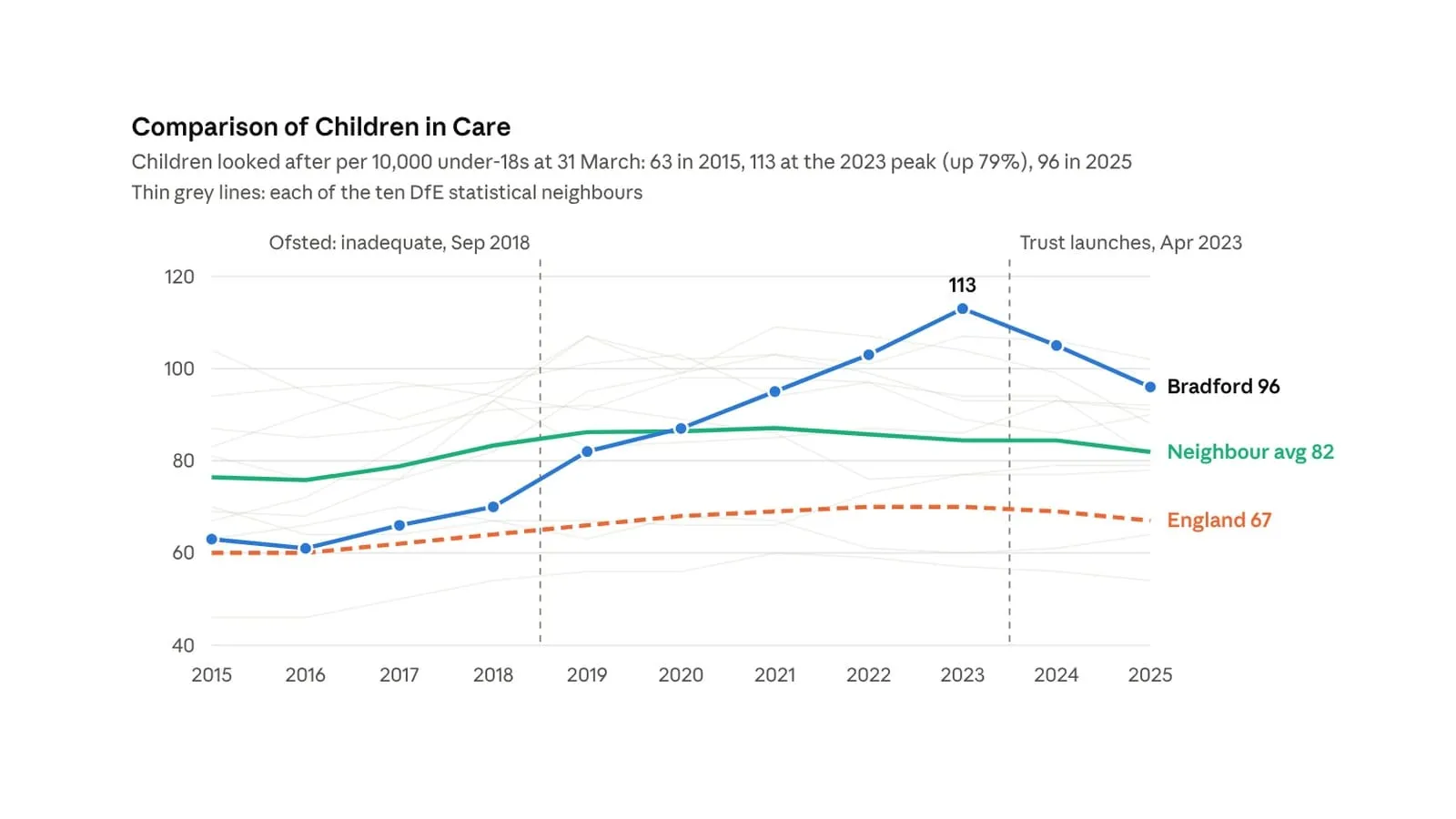
Before 2018, Bradford was unremarkable. Its rate of children in care was close to England's and below seven of its ten statistical neighbours — the councils the Department for Education says most resemble it.
After the judgement, it diverged. By 2023 Bradford had 1,584 children in care, up from 878 in 2015. England's rate rose 17% over the same period and the neighbour average 10%. More children in care meant more placements, and more of them in expensive external residential homes.
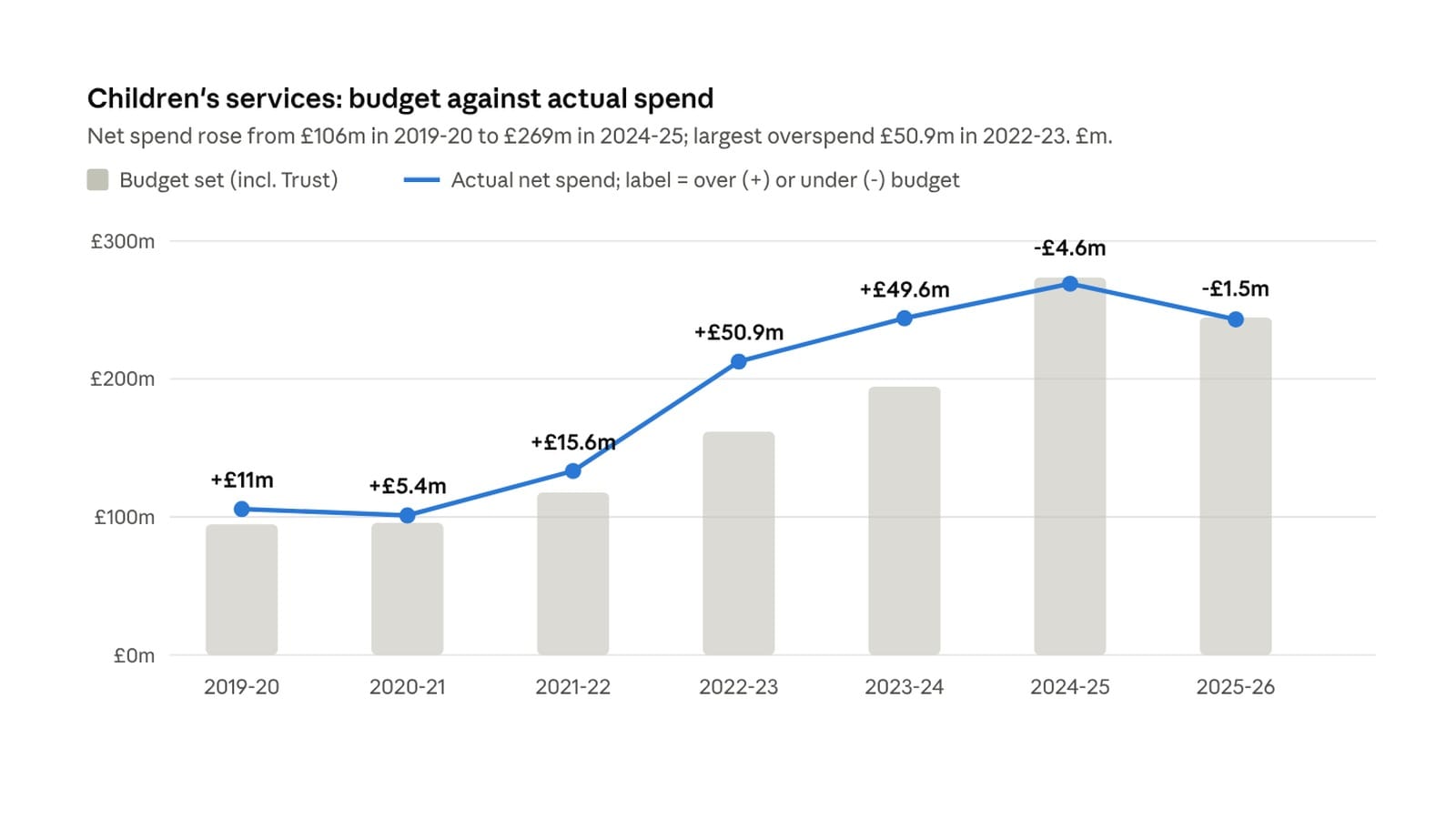
The money followed. Children's services spent about £106m net in 2019-20 against a £94.7m budget. By 2022-23, it spent £212.6m against £161.7m: a £50.9m overspend in a single year, according to the council's outturn report. In 2023-24 the new Trust overspent by £42.3m on a £170m contract, £32.8m of it on placements, £5.5m on agency staff.
Adult social care also overspent every year, by £8.8m to £14.2m from 2022-23 to 2024-25. It is the steadier, less reported pressure.
"Not local but national" — half true
In May 2022, the national Child Safeguarding Practice Review Panel concluded that the problems in the cases of Star Hobson and Arthur Labinjo-Hughes were "not local but national". The Telegraph & Argus reported it prominently. It is a finding about child protection practice: superficial assessments, family warnings dismissed as malicious, agencies not sharing information. On that, Bradford's failures matched a national pattern.
The price of placements was national too. The National Audit Office found councils' spending on children's residential care rose 96% between 2019-20 and 2023-24, to £3.1bn. The average children's home placement cost £318,400 a year. The Competition and Markets Authority found the largest providers made margins of 22.6%. Bradford paid about £312,000 per child: roughly the going rate in a broken market.
What was not national was the volume, and the workforce that drove it:
What | National or local? | Evidence |
|---|---|---|
Practice failures in Star's case | National pattern | Safeguarding review panel, May 2022 |
Placement prices | National | NAO: residential spend up 96%, 2019-20 to 2023-24 |
Children in care | Local | Bradford up 79%, 2015-2023; England up 17% |
Social work workforce | Mainly local | Agency staff up from 47 to about 218 (Walker) |
Budgets below actual cost | Local | CIPFA, October 2023 |
The way Star was failed fitted a national pattern. The scale of Bradford's collapse, and its cost, did not.
Reserves hid it. Inflation tipped it.
The council's own papers warned of the impending implosion. In April 2022 its year-end finance report said children's social care pressures were "growing at an unsustainable pace". Overspends kept coming, and the council covered them from reserves rather than cutting spending — an approach its current finance director now describes in the 2026-27 budget papers.
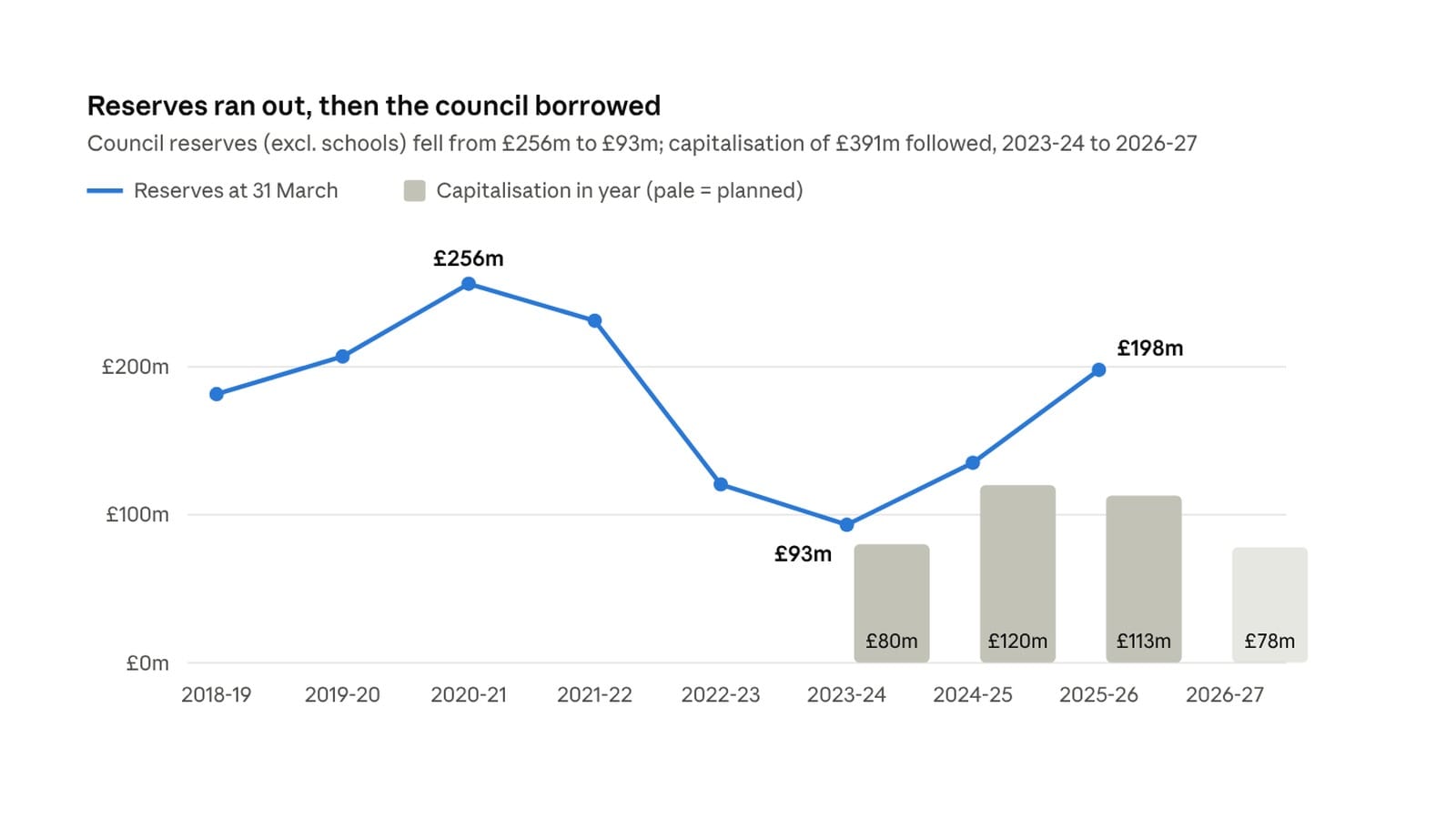
Reserves peaked in March 2021 at £256m, partly because the Covid grant had been carried forward. Then came 2022-23. Inflation added about £28m the budget never anticipated; a pay award cost £18.6m against £6m budgeted; energy ran £9m over. With a £50.9m children's overspend on top, the council drew £110.6m from reserves in one year.
The government-commissioned CIPFA review in October 2023 was blunt. The 2022-23 and 2023-24 budgets rested on "unrealistic budgeting of Children's Services". Overspends recurred because of "planning and control weaknesses". The Trust's £28m first-quarter overspend was not in the council's own forecast. CIPFA also disagreed with a retrospective accounting change that propped up about £23m of the 2023-24 position.
By March 2024 reserves were down to £93m. Nothing remained to cover the gap.
The bill, and who was in the room
Bradford applied for exceptional financial support in December 2023. The government treated day-to-day overspending as capital, funded by borrowing and asset sales. The final figures, from the council's outturn reports and MHCLG's 2024-25 and 2025-26 directions:
| Year | Capitalisation | Note |
|---|---|---|
| 2023-24 | £80m | Matched the request |
| 2024-25 | £120m | £20m below the £140m requested |
| 2025-26 | £113m | Below the £127.1m budgeted |
| 2026-27 | £78m | Planned; the last year if all goes to plan |
| Total | £391m | The figure the s151 officer gave the Executive on 3 Nov |
This is not free money. The council's 2024-25 outturn report says the borrowing will cost an estimated £33m a year by 2029-30.
The first £80m traces straight back to the Trust. It launched in April 2023 on a £170m contract, agreed while the government's commissioner oversaw the transition. CIPFA judged that price "not sufficient"; the Trust's own modelling had run as high as £222m. CIPFA said the council held firm on affordability while the Trust expected flexibility later. The Trust spent £42.3m more than its allocation in its first year.
So Bradford alone didn't set the contract that triggered the first year of emergency borrowing. Government was in the room.
A Reform recovery? It was built before they arrived
From 2024-25 the council stopped pretending. They wrote capitalisation into each budget at the start of the year, and funded services at what they actually cost. Then they came in under budget: by £3.0m in 2024-25 and £16.7m in 2025-26. The Trust stopped overspending. Year-end reports show savings of £48.6m and £44.8m were delivered or mitigated.
The number of children in care fell from 1,584 in 2023 to 1,366 in 2025. Children entering care fell from 42 per 10,000 to 24, below both England and the neighbour average. That fits what the Trust's chief executive, Charlotte Ramsden, told the Executive on 3 November: fewer children going straight from home into residential care.
All of that happened before the May 2026 election. So did the 2026-27 budget, and the Fair Funding settlement that cut the total borrowing requirement from about £570m to £391m.
Cllr Eglin said on 3 November that most of this year's savings are "continuation of existing programs that have been successfully delivered in the past". On that, at least, the record agrees with him.
One point deserves scrutiny. Over 2024-25 and 2025-26, council reserves rose by £104.7m — from £93.2m to £197.9m — while £233m was capitalised. Rebuilding reserves from a historic low was a stated aim. It still means part of the borrowing in those years ended up on the balance sheet rather than covering spending.
The recovery is not finished. The Trust balanced its 2025-26 budget only by covering a £9m placements overspend elsewhere. The deficit on the ring-fenced schools grant is forecast to exceed £100m by March 2028, held off the council's books only by a temporary government override. Those are now Reform's problems.
The story nobody joined up
The accountability story and the money story ran side by side for two years. Nobody connected them. Local coverage, led by the Telegraph & Argus, framed the failure as a question of who should resign. The trade press reported the workforce diagnosis to readers who mostly do not live in Bradford. The cost sat in finance reports few people read.
The national press also linked the trust decision directly to Star's murder. The commissioner's report did not examine her case; a separate review handled that. He found that the council had failed to improve after 2018 and would not do so on its own.
My take
Both parties are telling the half of the story that suits them.
Labour is right that Bradford was underfunded, that austerity started it, and that the recovery is mostly its work. It is wrong to suggest the crisis was wholly imposed from outside. The council's own reports flagged children's costs as unsustainable in 2022. Budgets stayed unrealistic. Reserves papered over recurring costs until they were gone. A Conservative-chaired Commons committee doubted the leadership in 2022; the government then removed children's services from direct council control. Those are not the marks of a council undone purely by Whitehall.
Reform is right that it should have been managed better. It is wrong to call the people who fixed it incompetent while presenting their savings programme as its own. Cllr Eglin cannot have it both ways: either the savings were "successfully delivered in the past", or the last administration couldn't manage money. Pick one.
The bigger failure is the media reporting. By 2023, every element of this story was on the public record. I suspect the problem is that local media shies away from this level of detail. Unfortunately, that is exactly what's needed to properly understand how events unfolded and their attendant financial implications. The commissioner's report, the parliamentary transcript, the outturn reports and the auditors were all there. The coverage asked who should resign. It rarely asked what the failure would cost. The answer is £391m of borrowing, around £33m a year to service it by 2029-30, and a children's services budget that went from about £95m to £245m.