
This is part one of a two-part investigation into Bradford Council’s 2027-28 savings plan. Part one looks at the Executive Member presenting it. Part two, on Monday, looks at what’s in it.
Cllr Ian Eglin is the Reform Executive Member for Corporate Resources. He is presenting Bradford Council’s £50m savings plan for 2027-28. Steven Mair, the s151 officer, is legally responsible for the Council’s finances; Eglin is the councillor who answers for them politically.
There’s a problem; Eglin won’t answer questions about the budget.
I sent him three on 28 October, each drawn from the Council’s own reports. He replied the next morning: “To my knowledge you have never said anything balanced or positive about Reform or myself, I don’t know why you think I would be helpful.” He suggested I “follow the local press and my Facebook Page if you wish to establish the Reform position on these matters”.
So I did.
Two years early through efficiency? Not so fast!
Cllr Eglin told the Local Democracy Reporting Service the Council was “on track to end the need for exceptional financial support two years earlier than originally planned”. He credited efficiency, productivity and better value from contracts.
Exceptional Financial Support (EFS) lets the Council borrow to fund day-to-day spending. The original recovery plan needed £570m of it. The current forecast is £391m, with none needed from 2027-28
The S151 officer’s report explains why. The Fair Funding settlement published in February raises the Council’s Core Spending Power by 47% between 2024-25 and 2028-29, including a 57% rise in government funding. That’s the highest increase of all 36 metropolitan councils. The Month 2 finance report to the Executive on 21 July says the settlement’s overall impact was to “reduce the EFS requirement from c£570m to c£395m” and bring the return to financial sustainability forward from 2029-30 to 2027-28.
That’s the same two years. The budget savings proposal document credits “the additional funding that the Council expects to receive following the implementation of the Fair Funding review”.
Cllr Eglin’s statement doesn’t mention it.
The public gets a say on 7%, down from 16%
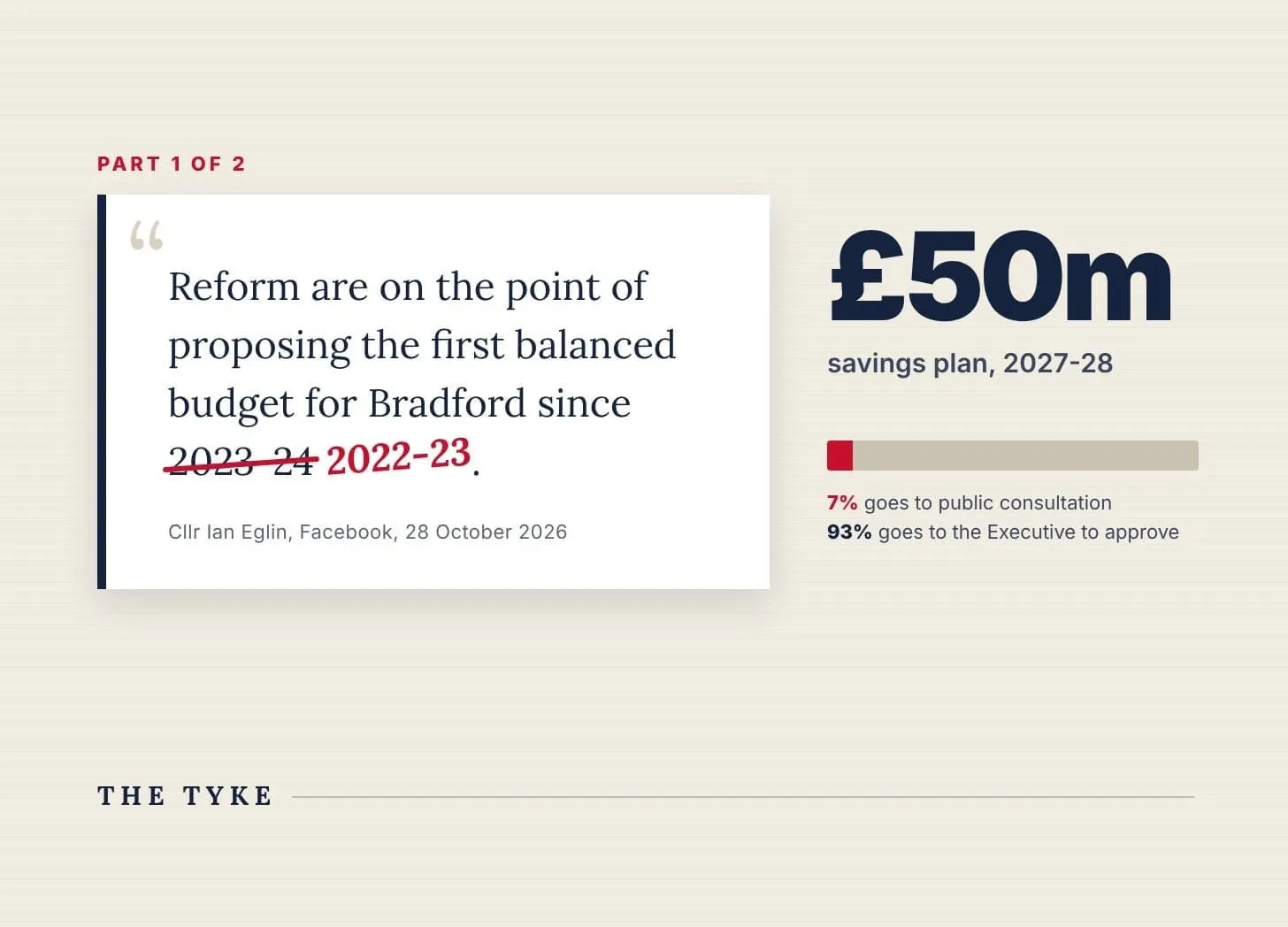
Last year, £9.8m of £60.6m in 2026-27 savings went to public consultation: 16%. This year it’s £3.58m of £50m: 7%. That covers leisure income (£0.21m), the Localities service (£0.5m) and a 3% rise in fees and charges (£2.87m).
Which proposals skip consultation, and on what grounds, is a question for part two. The report says respondents can comment on any proposal, not just the three.
What his Facebook page says
On the evening of 28 October, Cllr Eglin posted this on his Baildon Ward Facebook page:
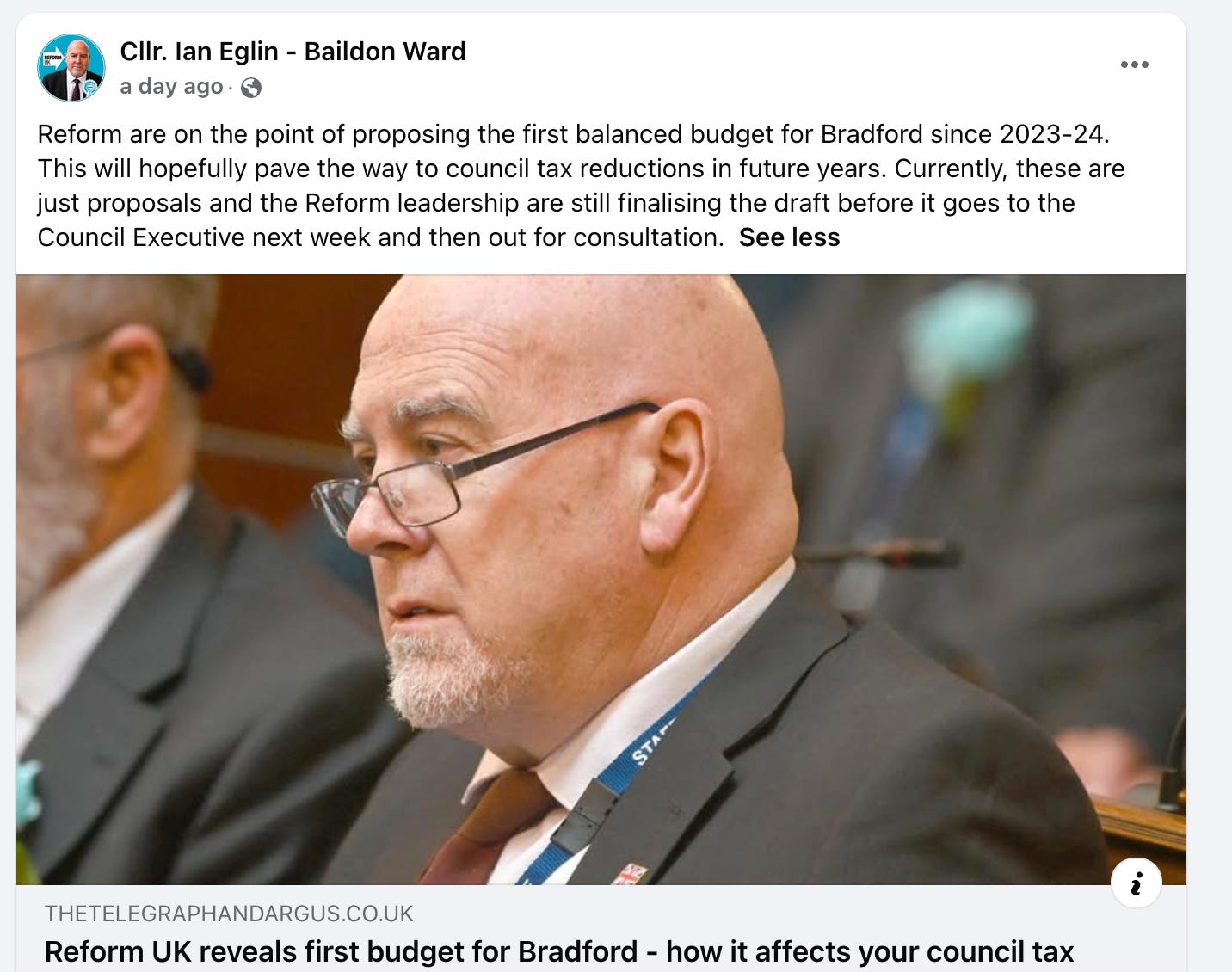
Here’s how that compares with the budget savings document:
- The year. The savings document says 2027-28 would be “the first financial year since 2022-23” without Exceptional Financial Support. 2023-24 was the first year the Council needed it: £80m.
- “Balanced”. Every council is required by law to set a balanced budget every year. Bradford has set a balanced budget in each of 2023-24, 2024-25, 2025-26 and 2026-27, with Exceptional Financial Support helping. What’s new is balancing it without EFS.
- “Still finalising the draft”. The report is already published in the public agenda pack for 3 November. It’s the s151 officer’s report, not a Reform draft.
- “Then out for consultation”. £3.58m goes to consultation. The Executive is asked to approve £46.42m on 3 November.
On council tax, the 2027-28 plan assumes a 4.99% rise.
I sent these additional points to Cllr Eglin, along with a question about ward surgeries, and asked whether he would correct the post. He had not replied by the time of writing this story, and his post was still up, unchanged.
My take
Cllr Eglin is entitled to refuse an interview or to answer questions. But he is the cabinet member presenting a £50m budget savings plan, and the source he offered instead gets the key date wrong and describes £46.42m of approvals as a consultation.
The Tyke is not the only audience he has stepped back from. In June he told a Baildon resident he didn’t intend to run a ward surgery “at the moment” but would meet people in person if email wasn’t enough. He added that the other two Baildon councillors would probably be more active on ward issues while he concentrated on Corporate Resources. Five months on, I can find no record of him holding one. His councillor page on the Council’s website lists no surgeries. The Leader’s, Cllr Stephen Place’s, lists his.
Executive members are busy. That’s the job. Explaining the budget savings to the people paying for it is part of the job too, and a Facebook post isn’t an audit trail or an explanation. Years spent watching how large business salespeople work a crowd taught me that when the person selling the product won’t take questions, you read the small print twice. Preferably with a legal interpreter. Here, the small print says the funding settlement bought an early exit from emergency support, and the public won’t be asked about most of the savings.
The Executive meets on Tuesday 3 November; scrutiny sees the plan on 12 November; consultation runs to 16 December on any proposal you like.