

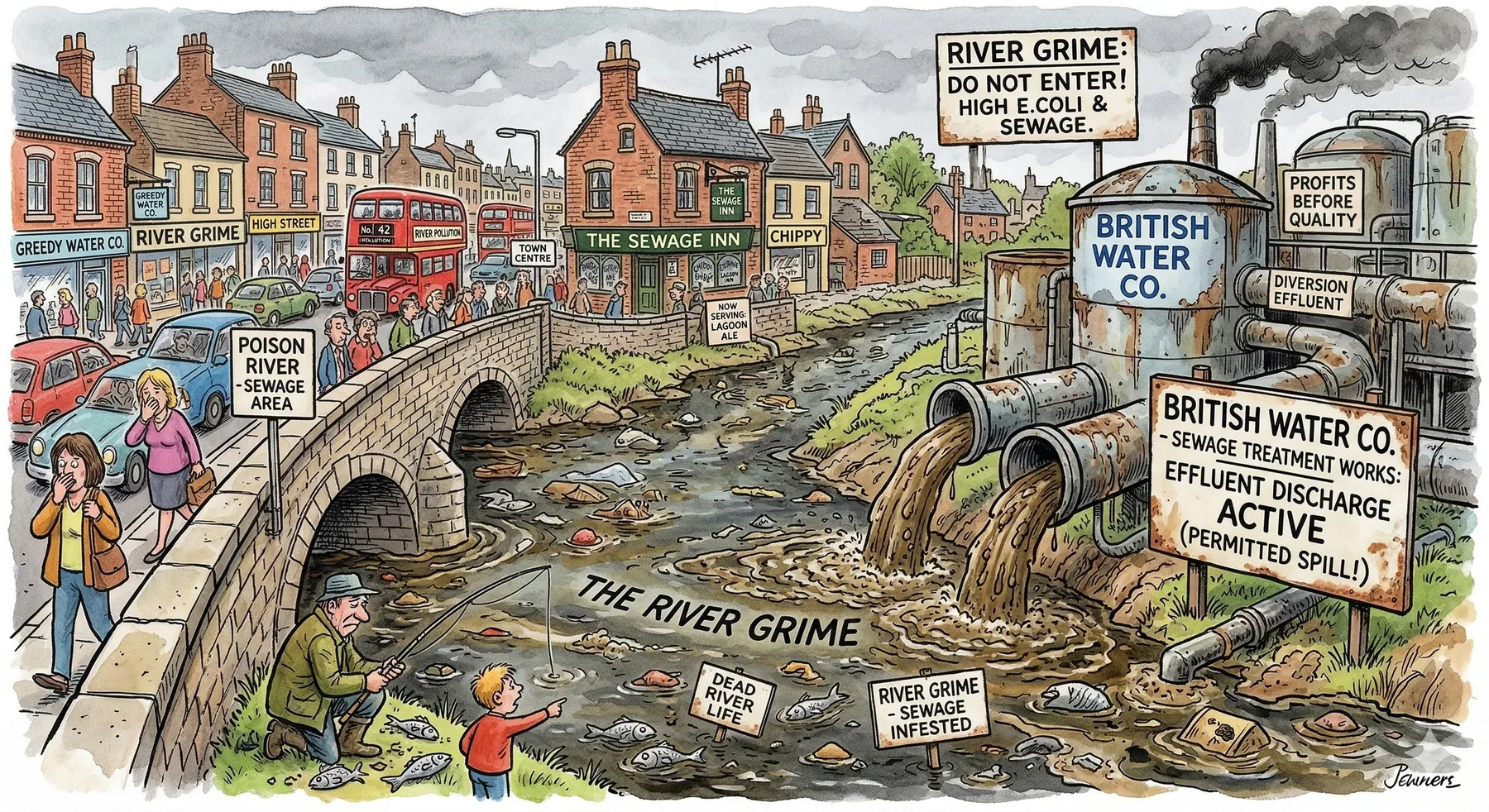
How well did Robbie Moore, MP for Keighley and Ilkley, perform in the last Tory government, particularly around his responsibilities as a junior water minister on water management, transparency, and local outcomes? How does that compare to Anna Dixon, my MP, who represents the adjacent constituency, who holds no such ministerial position but engages on similar issues as a backbencher? The results to date shed light on an ineffective, myopic minister who actively sought to suppress damaging information while being concerned only with his own constituency.
Reading his words on Facebook, you’d be forgiven for thinking that Moore has done a fantastic job. I would post a link to his most recent Facebook post on the topic, but, along with many others who offer criticism, I am blocked from viewing his page. Thankfully, a colleague sent a screenshot of the content, which I’m happy to reproduce for your delight. It’s not 100%, but you get the gist.
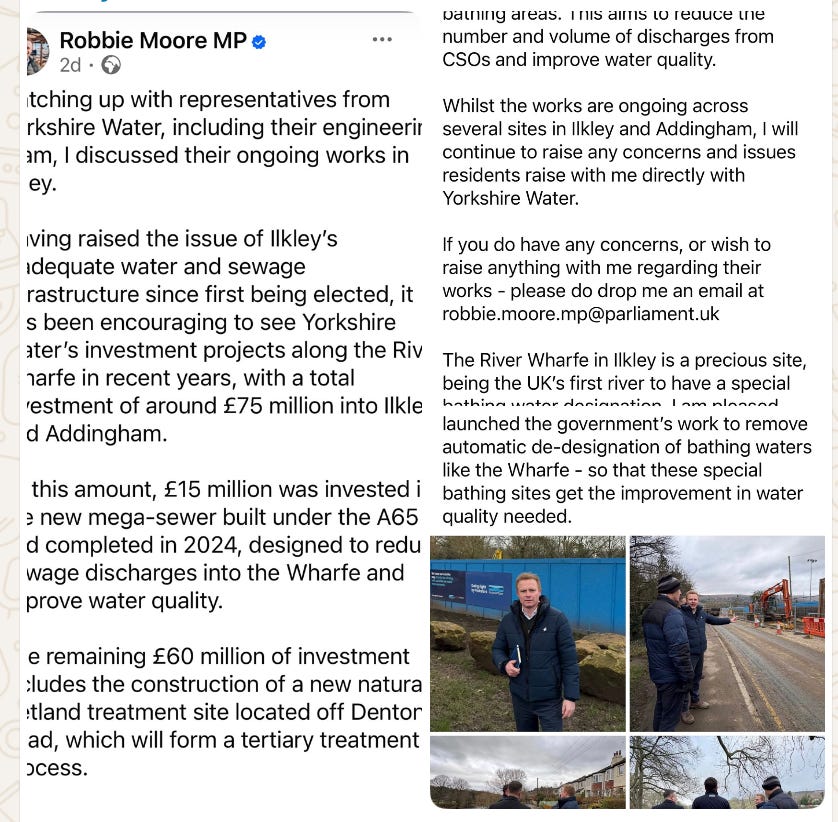
Impressed? It is no small feat to have secured some £60 million for local improvements, and for that, Moore is warmly congratulated. But was his contribution while a junior minister consequential? Rather than digging through Hansard, I asked Claude to do the heavy lifting, starting with this question focused on one of the ;largest water companies and one that serves mine and his community:
Using Hansard as your primary source, summarise the number of times Robbie Moore MP mentioned Yorkshire Water, referencing towns in West Yorkshire, focusing on effluent management.
Claude had this to say:
Key Observations
- Ilkley is by far the most frequently cited West Yorkshire town in Moore’s contributions — specifically in the context of the River Wharfe’s sewage contamination from Yorkshire Water’s storm overflows and sewage treatment infrastructure.
- Keighley appears in debates largely in his title as constituency MP, not as a specific focus for effluent complaints.
- The term “effluent” is rarely used by Moore himself; he consistently refers to sewage, storm overflows, and discharge — the language more common in this area of parliamentary debate.
- Moore’s role as Water Minister (Nov 2023–Jul 2024) shifted some of his contributions from criticism to ministerial accountability, though his focus on Ilkley and the Wharfe remained a consistent thread throughout his parliamentary career.
I asked Claude a supplementary question:
Viewed critically, assess Moore’s effectiveness at holding Yorkshire Water to account.
After all, one of the primary responsibilities of any MP is to hold (quasi) public services to account. While lauding Moore’s achievements at the local and hyperlocal levels, the AI is less impressed with his broader achievements, concluding that:
He inherited and then presided over a regulatory framework that could levy fines but not collect them, that could designate bathing sites but not guarantee their safety, and that could not prevent dividend extraction while infrastructure crumbled...
The uncomfortable conclusion is that Moore was most effective as a local advocate and most limited as a systemic reformer. That may be an honest reflection of what a backbench and junior ministerial MP can realistically achieve against a well-resourced utility operating within a legally permissive framework — but it is a limitation nonetheless.
What about Anna Dixon, the first female Labour MP to be elected in my constituency? A meaningful comparison requires examining their respective roles (Moore as both campaigner and minister; Dixon as new MP), time in office, and specific approaches to water management and accountability. Is it possible to compare what Dixon has achieved in 18 months as a new MP with Moore’s performance across both his campaign and junior ministerial tenure? Claude says:
Where Moore’s Hansard contributions tend toward the local and the symptomatic, Dixon operates at a more structural level of critique. She directly challenged the labyrinthine holding company structure of Yorkshire Water, arguing it had been used to build up debt, extract dividends and interest payments, drive up customer bills and defer infrastructure investment. Parallel Parliament
More strikingly, Dixon deployed her own household bill as forensic evidence. Citing her own Yorkshire Water bill, she pointed out that 23% of it went solely to finance debt, while only 17% was directed at infrastructure investment, questioning how that ratio could be justified. (Yorkshire Post)
This goes well beyond anything in Moore’s Hansard record, where financial structure is rarely examined.
The media conundrum
Who would have known that? This is where the story becomes more nuanced as we consider the two MP’s use of media and social media:
Moore is the more experienced media operator in the traditional constituency sense — five years of relationships with local titles, broadcast experience as a minister, and a well-maintained personal news website. But his social media profile has become a liability, and his post-ministerial coverage on Yorkshire Water has been partly crowded out by controversy of his own making.
Moore’s social media aggression became a liability after Moore attempted to throw shade against Dixon on the unrelated grooming gang issue that resulted in death threats aimed at Dixon. In Claude’s reading, this has backfired spectacularly:
Dixon, in eighteen months, has demonstrated a more disciplined and arguably more effective earned-media strategy: using her own bill as evidence, leveraging committee scrutiny for press pickups, and deploying petition mechanics to force a public response from Yorkshire Water itself. Her reach into national outlets on the structural finance questions around Yorkshire Water has been more consistent than Moore’s, and without the reputational noise his social media approach generates.
The irony is that Moore, the more experienced communicator, is increasingly undermining his own media effectiveness through the very social media aggression that built his profile — while Dixon, the newer MP, is quietly building a record that is harder to dismiss.
Look over there, not over here
But it doesn’t end there. A colleague with a better memory than I for the detail asked Claude about reported attempts to suppress information pertinent to sewage issues:
In March 2024, emails obtained by Greenpeace’s investigative journalism outlet Unearthed through Freedom of Information requests revealed that Moore, as Water Minister, repeatedly ordered the Environment Agency to remove headline figures about the total number and duration of sewage spills from a new public data portal before it was published.
Unsurprisingly, Moore’s office stayed silent on the issue. I am sure Moore would prefer it to be fully airbrushed from the memory of his time in office. Thankfully, AI assistants like Claude allow us to see more than is usual in our frenetic media world. In this case, Claude serves as an apt reminder that for all the burnishing of careers in which MPs routinely indulge, AI’s ability to be as unflattering as the sharpest media columnist is rapidly improving.
Who wins?
Securing local investment always plays well, and Moore’s record demonstrates that. However, as a former - albeit junior - minister, he cannot avoid the record, which shows plenty of talk but very little structural action or improvement coupled with a determination to airbrush inconvenient truths.
Continuing pressure from MPs and the drumbeat of national criticism make a difference, and on this measure, Anna Dixon marches gamely on. To its credit(?), Yorkshire Water is investing heavily with an ambitious plan for 2025-30, paid for by an estimated 41% increase in our bills over that period. It is a part improvement, part recovery from years of underinvestment.
On effectiveness, Claude makes the point that no amount of social media glitter can make up for an MP’s time in power when the mess the water companies made was all but ignored by a government more content with supporting unfettered profits and unmanaged effluent. It is a well-made point. What do you think?
As an aside, isn’t it the mark of a coward who prefers unalloyed praise for his work rather than accepting the balance of a measured critique? I leave you with the words of Sir Walter Raleigh:
But it is hard to know them from friends, they are so obsequious and full of protestations; for a wolf resembles a dog, so doth a flatterer a friend.
And yes - I know AI is far from flawless but on this occasion, it has produced a result that tends towards the kind of balance that makes me go: Hmmm. And that’s a good thing.