

As we move into the annual budget period, Bradford’s Reform leadership is describing the district, and more particularly the city centre, as a hellscape from which only their madcap policies can save the populace.
In doing so, their leadership builds on the contradictions first displayed by their council leader Stephen Place shortly after being elected, neatly parcelled in the soothing language of ‘common sense.’ It makes no sense and relies entirely on a vision that defies reality in favour of bad-faith vibes.
When council leader Stephen Place first pushed his message of grievance, voters nodded in agreement and elected him and his team to 28 council seats. But when your team keeps that same tone more than four months into the job, some things don’t add up.
Hellscape or fun zone?
The most recent glaring example comes from setting Place’s oft-repeated rhetoric that ‘Bradford is open for business,’ bolstered by his promoting a business event to be held in October, against claims at a recent Bradford Wellbeing Board meeting that:
Cllr Birch said: “Compared to two or three years ago, the city centre feels more unsafe.
“I used to come into Bradford three years ago, it didn’t phase me. Now I won’t do that on my own. It might be because I’m female, but I get a sense when I’m out that there are so many people that are aggressive and with mental health issues.
I struggle with this depiction because, for a start, ‘two or three years ago,’ the centre was in the midst of a highly disruptive regeneration and pedestrianisation project. At the time, I vividly recall the centre being a mess, with retailers complaining about the impact on footfall. Today? According to Cllr Ian Eglin:
No one with money comes to the city centre. If people do, they scuttle to the Alhambra but don’t stop for a drink or a meal in a restaurant.
Before going on, it’s worth noting that both the above claims were made in the context of a discussion about crime and Reform’s insistence on leaning into perception rather than reality. The central question is simple: what is the reality?
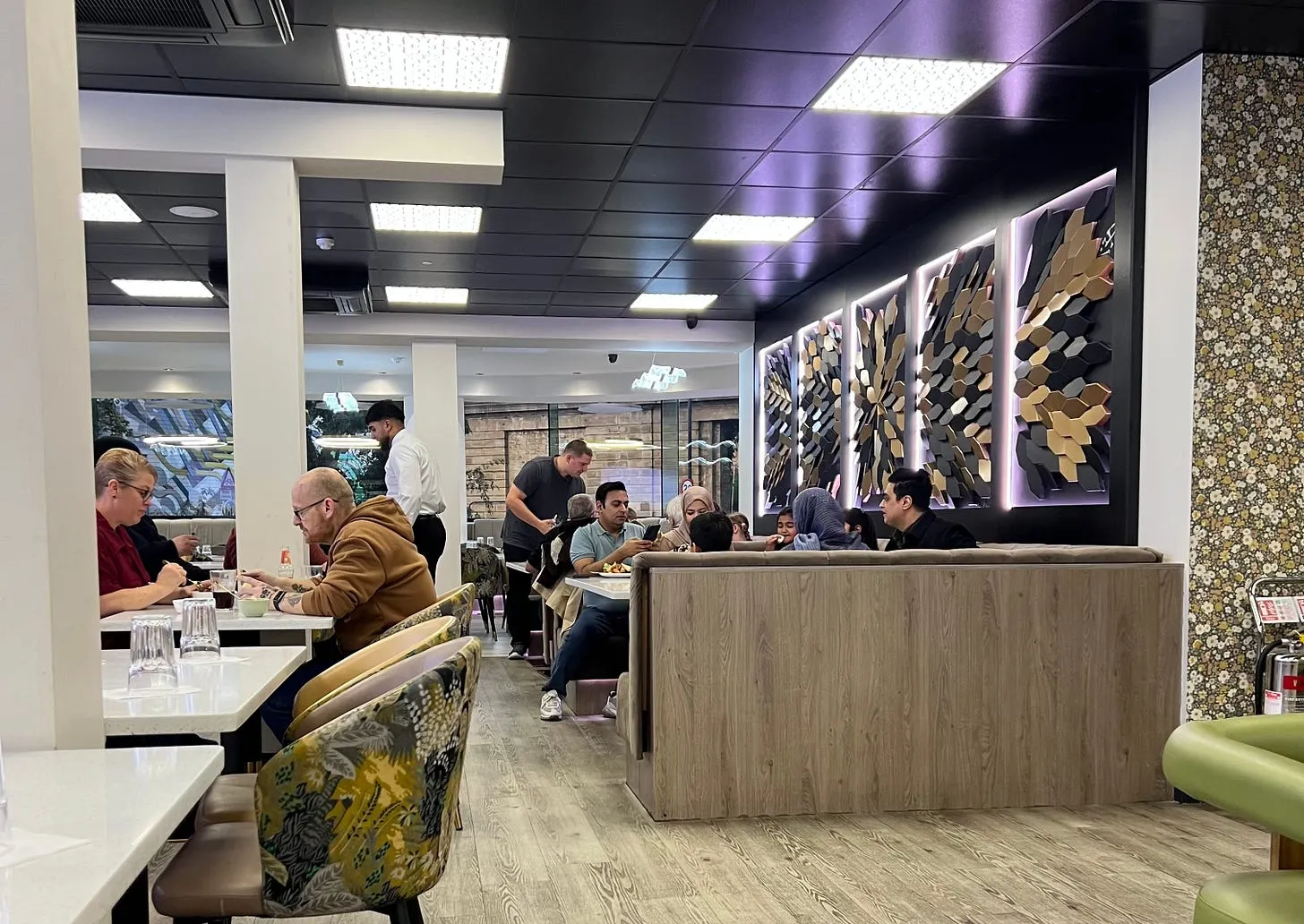
I’m a fairly regular theatregoer. Last evening, my wife and I enjoyed Gary Delaney’s stand-up show, along with a near full house of some 1,200 others, at St George’s Hall. Before that, we had a great meal at the recently opened Golden Palms, a multi-million-pound investment in Bradford’s hospitality sector. We had to queue for a table, and the place was doing brisk business at £29 a head for their excellent buffet. When we left the restaurant, around 50 other diners, including families, were enjoying the offering.
The previous evening, I left City Hall at around 7 pm and saw many groups, both young folk and families, in Centenary Square enjoying the fading light. It looked like ‘Spoons was doing good business. On neither occasion did I get a hint or whiff of the safety issues Birch so pointlessly claims.
If Bradford centre is such a hellscape, then why would Bangkok Thai offer a cheery pre-theatre dinner at £20 a head? Or why would the queue at St George’s Hall bar hold up patrons until almost the last minute before the show starts? Or why does Bradford Council push out a regular drumbeat of adverts for events in the district, including the centre?
Or why does Council Leader Place actively promote the Fan Zone at the city centre Darley Street Market?
Sorry, Cllrs Birch and Eglin, you are talking culture war nonsense and doing the exact opposite of what your leader wants to encourage.
More worrying is the insistence that perception is reality. That claim creates a narrative that plays directly on people’s fears, selling the lie that Bradford is on its knees, continuing to decay and beset by marauding thugs of all descriptions.
Crime everywhere?
Returning to the crime issue, the police-reported indicators show that crime in Bradford is generally declining. But that needs to be tempered by the fact that Bradford does not perform well when compared with its peers and some crime categories are troubling. However, on the perception topic and contrary to what Reform leaders claim:
Chief Superintendent Richard Padwell, of West Yorkshire Police, said West Yorkshire Combined Authority recently carried out a “community confidence” survey, and the results would be published soon.
He said he had seen the results of the survey, which questioned hundreds of Bradford residents, adding: “The results are very interesting, it shows confidence safety and quality of life have improved in Bradford, and are better than in other parts of West Yorkshire.”
He suggested City of Culture played a big part in this, adding: “There was very little police intervention required in any City of Culture events. We’ve also seen the physical infrastructure change in the city centre. There are some positives, as it seems perception of Bradford is starting to shift.”
Even so, Cllr Andrew Judson, Deputy Leader, insisted that:
Looking at anti-social behaviour, (ASB) people on the ground say it’s increasing, but people aren’t reporting it.
It becomes the norm and people don’t report it – you have to acknowledge that. Getting through to police can be difficult. People can’t be bothered.
These figures look fantastic, but they are misleading because of underreporting. Bradford city centre doesn’t feel safe.
This is yet more fear-mongering nonsense, delivered with all the certainty of someone who hasn’t checked the latest Neighbourhood Watch reports or, for that matter, the police statistics that are freely available to anyone who enquires. I can assure Judson that ASB, especially the menace of illegal e-bikes, is regularly reported and is an issue my local MP has taken up.
Cllr Birch digs herself into a deeper hole when she reports that:
…she recently saw a man suffering a mental health emergency in the city centre, while a line of people looked on.
Has she never heard of the well-documented bystander apathy phenomenon? Or seen reports of thugs attacking others while crowds look on? This is nothing new, unusual or specific to any large city centre. It is absolutely nothing to do with reported crime or unique to Bradford.
My take
When offering a critique of Reform’s leadership, I frequently get the cut-and-paste pushback of: ‘Wake up and smell the coffee.’ I did, last evening; it was delicious and at £3.80, a good deal.
It’s time for Bradford’s Reform leadership to set an agenda of hope. Rather than doubling down on wildly inaccurate perceptions, it should lean into a data stream that demonstrates encouraging progress. There is no harm in recognising where improvements are needed, and no one would disagree with that premise. But continuing to parrot the negative line that took you into power says more about what you, as leaders, have not done than it does about the 563,000 people who call Bradford district their home. Nor does it give confidence to those who are willing to invest.
Put bluntly, it’s time to get off the pity pot and show us some innovative ideas that capitalise on the investments made by the previous administration. So far, there have been none.