
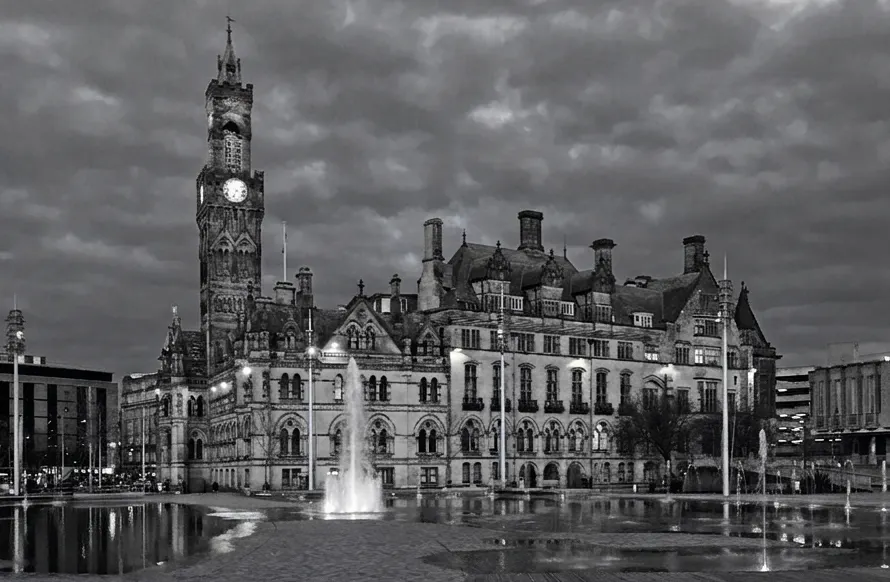
Last week, Bradford council went from Labour to no overall control (NOC) as Labour slumped from 46 out of 90 seats to 17. Reading the table below, it is easy to see that there is an expectation that Reform and the Tories, with their combined 47 seats, will form a relatively comfortable governing coalition. There is an interesting alternative scenario. Check the table of results.
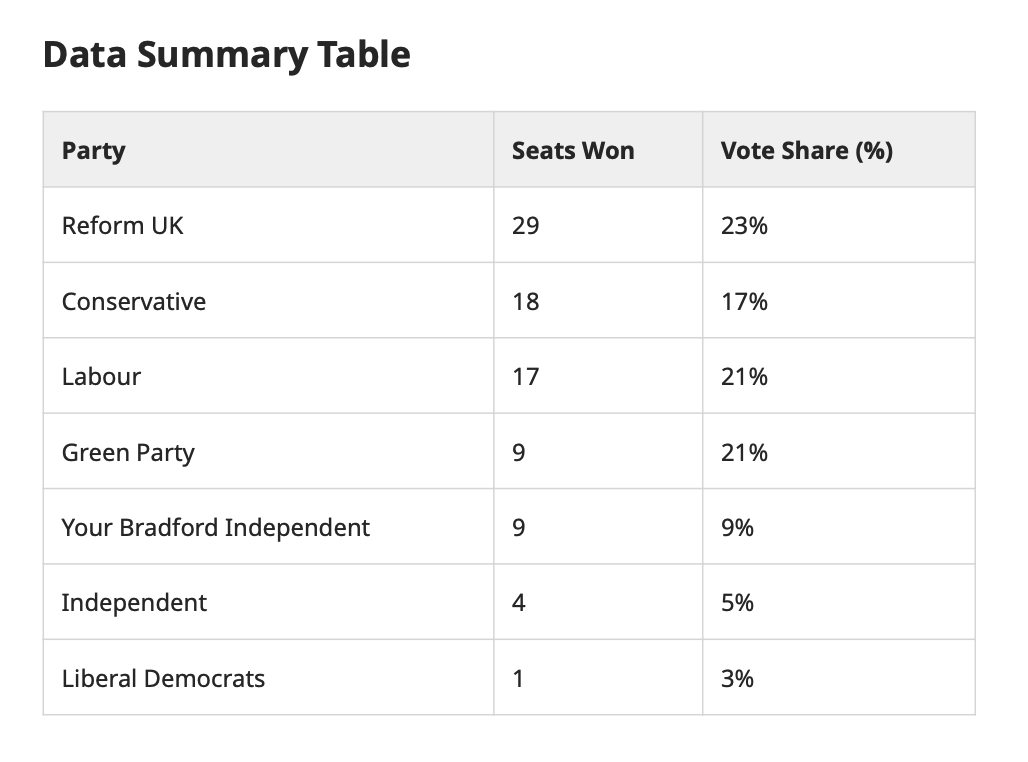
However unlikely this might sound, there is a scenario where the Tories, Labour, Greens and a couple of Independents form a majority coalition with a combined total of 46. A group of Independents would be effectively sidelined, but I would be surprised if the LibDems/Dems didn’t fold into this coalition. This scenario shuts out Reform from governing because the math no longer adds up.
My MP has talked about electoral reform in the past, but it has been a ‘back burner’ project rather than a topic requiring top-of-mind attention. Viewed through the lens of the Bradford 2026 election result, electoral fracturing and under- and over-representation are exactly what proportional representation seeks to address.
Now wind the clock back.
At the 2024 Labour Party Conference, I asked Sir John Curtice for his thoughts on the most important lesson Labour needed to take from his post-election analysis. For reference, Curtice is the UK’s leading pollster and elections analyst. When Curtice speaks, Prime Ministers usually listen. Curtice reminded the audience that Labour’s general election victory was thin and fragile. It was a vote against the Tories. He was clear that the result was NOT a ringing endorsement of Labour’s manifesto, despite having achieved a thumping majority. He pointed towards the fracturing we see today and hinted at the need for electoral reform. Curtice is no campaigner, but in my mind, he came pretty close. Check this quote from a story in Electoral Reform Society:
The heavily disproportional outcome of the 2024 election appears to have created – for the time being at least – a public that, irrespective of partisanship, is questioning the current electoral system to an unprecedented degree.
Curtice was sounding the alarm bell at exactly the time Labour was near blind drunk on its own success, despite being about to fall flat on its face with the disastrous Winter Fuel Allowance issue. I knew then that Labour would be in trouble locally, as we already faced severe financial difficulties. Adding in a WFA SNAFU doesn’t help.
Tee’ing up a 9.99% council tax increase while reporting massively overspent capital projects was never a vote-winning recipe. Those things live long in the memory. Despite what many colleagues think about the national agenda's effect on our recent results, it would be criminal to offer an analysis that ignores the impact of tax and spending factors in a council beset by structural poverty and chronic underfunding.
Seen through that lens, the possibility of a Reform/Tory alliance in Bradford makes some sense. When an electorate has told you that they want change, then this coalition seems to be far more radical than a mashup of the kind I’ve suggested. Except there are a few big problems.
When the 2026-27 budget was settled, the Tories proposed a 3.99% increase. That might be of immediate interest to Reform, as they pride themselves on smaller increases than Labour-controlled councils. The fact that the Tory proposals meant cuts in core services is not a minor inconvenience. Bradford is running on fumes as it is. But that is not how Reform plays the game, even when it has little idea what it is doing.
In the alternative power-sharing scenario, there is one Tory beef that could be accommodated. They have long argued for the sale of One City Park, a modern city development that makes little financial sense and even less cultural value. The money released would be a real cash saving, even though it would almost certainly mean a large book loss when set against the cost. The Tories would dodge a bullet because the loss is built in and doesn’t affect their ability to pay the bills.
What else? I see this as an opportunity for Labour. How does that work? Labour lost all its senior leadership, including the council leader, the person charged with regeneration, planning and transportation, and the portfolio holder for children, who retired. These are arguably the most important positions in the Bradford district. Filling them will not be easy. However, in a coalition of the kind I am imagining, there is still good expertise and experience to tap. It also means Labour can coalesce around fresh leadership with fresh ideas. I can’t see that so easily in a Reform/Tory alliance.
And then there is the potential for chaos. The Your Bradford Independents are an ill-disciplined group at the best of times. That’s not opinion, that’s a fact you can test at any full council meeting. They’re also all of South Asian heritage. Can you imagine the frothing coming from the Reform benches, especially if they were to table a full-on grooming gang inquiry motion, manufactured by Reform HQ? Someone has already jumped in. Would the Tories want to get involved? Wouldn’t it be much easier to manage them if facing a broad coalition that could accommodate at least some of their wishes?
Taken to a natural conclusion and assuming these kinds of results stood, then Reform could perform a valuable function as part of a PR governing body. They are constantly going on about potholes and fly-tipping. They could own those topics, fulfilling pledges they have made across the country and locally. Perhaps make some genuine savings? Having that degree of focus might avoid some of the recent failures. That level of speculation is for another day.
Whatever happens locally, the support for PR around the country is bound to accelerate. At the very least, it would help encourage higher voter turnout and the necessary development of a democracy that is at risk of falling apart. In the meantime, I’m grabbing a very large bag of popcorn and strapping myself in for what is going to be an interesting ride over the next couple of years.
Endnote: There is a slight complication in the maths in the table. There is another ward election to come following the untimely death of a councillor during the election period. The death automatically triggers a by-election, effectively delaying that polling for three seats. Last time, the LibDems won all the way around.