
If you are one of those who think rough sleepers fall (sic) into the category of ‘undeserving poor’, then click away.
The T&A (paywall) has some good news for Bradford council. The council-led Homeless Outreach Partnership (HOP) has won gold in the housing category at the Local Government Chronicle Awards — a genuine and deserved piece of recognition for a team that does some of the hardest work in local government. Commissioned in 2019, the 12-strong multi-agency partnership brings together drug and alcohol workers, complex-needs workers and housing options specialists, and works directly with people sleeping rough across the district. Its coordinator, Clare Flannigan of Horton Housing, prides the group’s work, characterising it as a service that “will not give up on anyone.”
Rough sleeping is not everyone’s favourite topic and often draws unkind, ill-informed comments when the T&A covers the issue. It is in that context that I went on a deep dive to better understand the scale of what Bradford deals with and its success (or otherwise) relative to the rest of the country.
A snapshot
Every autumn, each council in England produces a single-night estimate of how many people are sleeping rough in its area. It is a blunt instrument — one night, sensitive to the weather, to where people choose to bed down, and to the method a council uses — but it is the official, independently quality-assured measure, and it is the one ministers and funders watch.
Because Bradford’s numbers (tens of people) and England’s (thousands) can’t share a scale, the chart below indexes both to their 2010 level — each line starts at 100, so what you are seeing is relative change. It makes one thing immediately clear: for years Bradford tracked below the national trend, then broke away sharply upward in 2023.
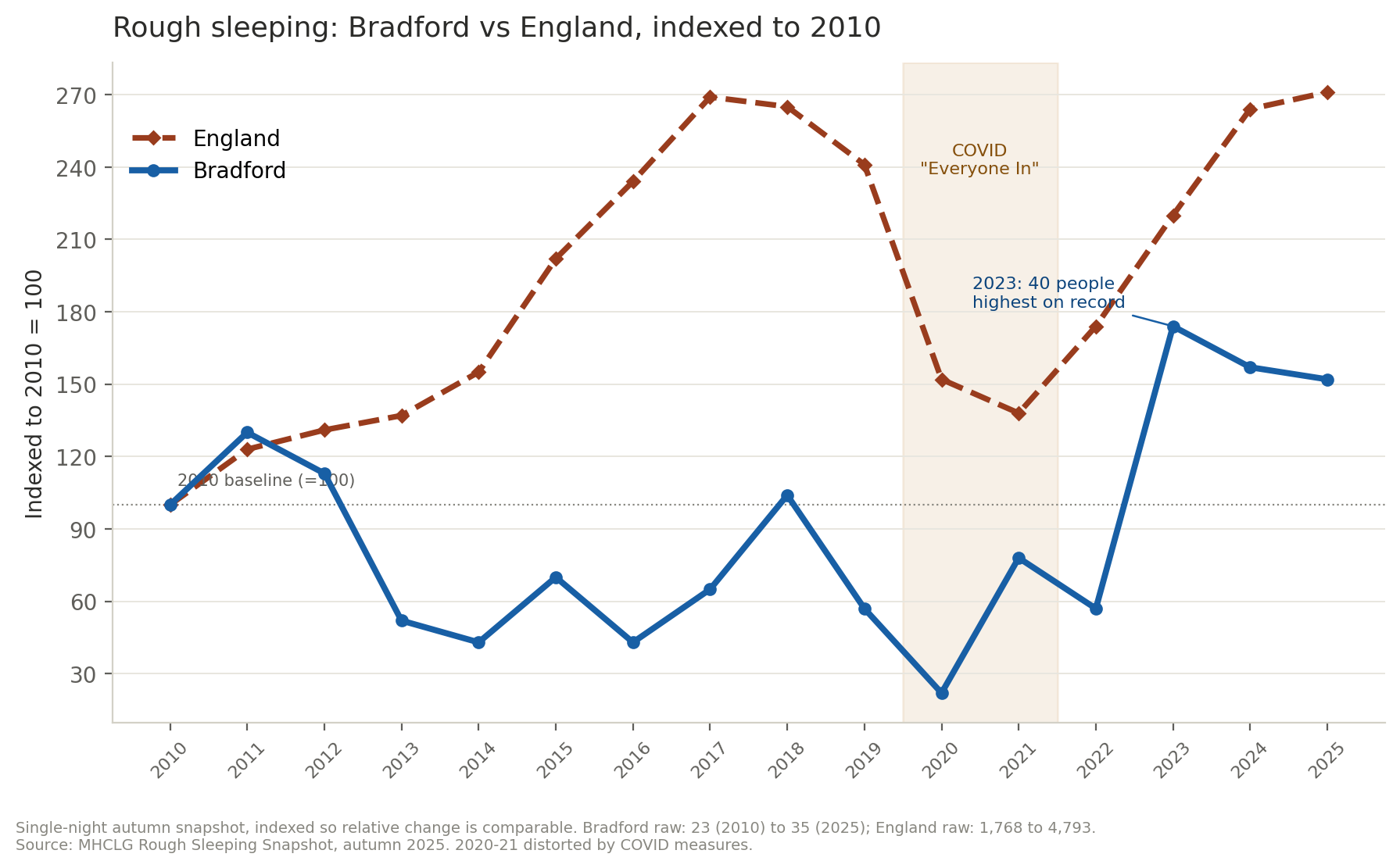
Source: MHCLG rough sleeping snapshot, autumn 2025. Single-night estimate. The 2020 and 2021 figures were depressed nationally and locally by the pandemic “Everyone In” scheme and are not comparable with surrounding years.
Bettering the national trend, until it didn’t
For most of the 2010s, Bradford did better than the country. As England’s rough sleeping more than doubled between 2010 and its 2017 peak, Bradford’s stayed in single figures or the low teens, and actually fell through the middle of the decade, reaching just 10 in 2016. Bradford was a national outlier in the right direction. The partnership launched in 2019 into that context, and the pandemic years that followed pushed numbers down everywhere.
And then in 2022-23, there was a massive spike, followed by a steady (ish) drift downwards. England’s numbers rose over the same period and hit a record 4,793 in 2025. Across the Yorkshire and Humber region, rough sleeping fell 15 per cent in the most recent year. Bradford, on these figures, has been moving against its own region — sitting at roughly three times the level it recorded a decade ago, at the very moment the team working on it is being recognised nationally.
Ah yes but…
Before anyone’s head explodes, it is vital to get these numbers into a sensible context. Bradford’s raw numbers are small. When you are dealing with counts of ten, thirteen, and forty, a swing of a couple of dozen people looks dramatic in percentage terms, even when the underlying reality has shifted only modestly. A single-night count is not a measure of how many people experience rough sleeping across a year — the government’s own monthly data suggests the true flow is roughly twice the single-night figure. Returning to local reporting, Bradford’s long-running Housing First program can support 40 people per night. As recently as January, 2026, emergency cold weather beds were provided for 70 people. Whose numbers do you want to believe?
My sense is that the manner in which rough sleeping is reported is inconsistent in the sense that numbers for those who are commonly understood to be rough sleepers are not the same as those who are on the street in the literal sense of the word. The selection of a random date across the country doesn’t help, especially when you know that we can experience all four seasons in a 24-hour period. This mish-mash combination of factors makes meaningful comparisons tricky, but we do at least have long-run trends.
Why both things are true at once
It is tempting to read an award and a rising number as a contradiction. They are not. Outreach teams do not control the forces that put people on the street. They are picking up the pieces. A team can be excellent, and the numbers can still climb, because it is battling a rising tide it did not create.
That is the real story the figures tell. The Homeless Outreach Partnership has, according to those who work with it, transformed individual lives, and the national judges agreed. It has not stood still despite the many pressures on its service. But recognition for the response should not be mistaken for progress on the problem. On the official measure, rough sleeping in Bradford is at or near its worst level since records began — and the administration now responsible for the district’s housing and homelessness services inherits a number going the wrong way. How will it respond? That has yet to be revealed.
With that in mind, it was good to hear Jayne Morgan, who holds the newly formed Healthy People portfolio, being quoted as saying:
This award is testament to the hard work of the Homeless Outreach Partnership who are on the streets every day offering support and accommodation to those in need.The HOP has transformed the lives of some of the most vulnerable people in this district.
It is a truly pioneering approach in the way that it is so collaborative with many partners.
I wish to accompany the team on the street soon, so that I can support the team and see their hard work for myself.
That’s the least we’d expect but in the meantime let’s hope that the new council sticks to its word and continues to fund this much -needed service when budget time comes around.
Hopefully, the words of former councillor Alex Ross-Shaw will play a part in the decision-making. Talking of HOP’s origins, he said:
We gave them our political backing to come up with the plans, and we worked with officers during those austerity years to put together a budget to make it happen, and they've been quietly transforming the lives of our most vulnerable residents ever since.
Figures in this piece are drawn from the Ministry of Housing, Communities and Local Government’s rough sleeping snapshot (autumn 2025 release) and statutory homelessness data. Rough sleeping is a single-night estimate and is distinct from statutory homelessness, which counts households owed a duty by the council.