
This is a tale of irony — not ironic in the literary sense, but possibly instructive.
Despite the many political differences between those aligned with Labour, the Greens, and Reform UK, the reality of people’s lives — their aspirations and their reasons for voting as they do — is thoroughly ordinary, rooted in lived experience that is often missed by those pressing the policy buttons. Nowhere was that more apparent to me than at the Gorton & Denton by-election, where I served as a teller for the Labour Party.
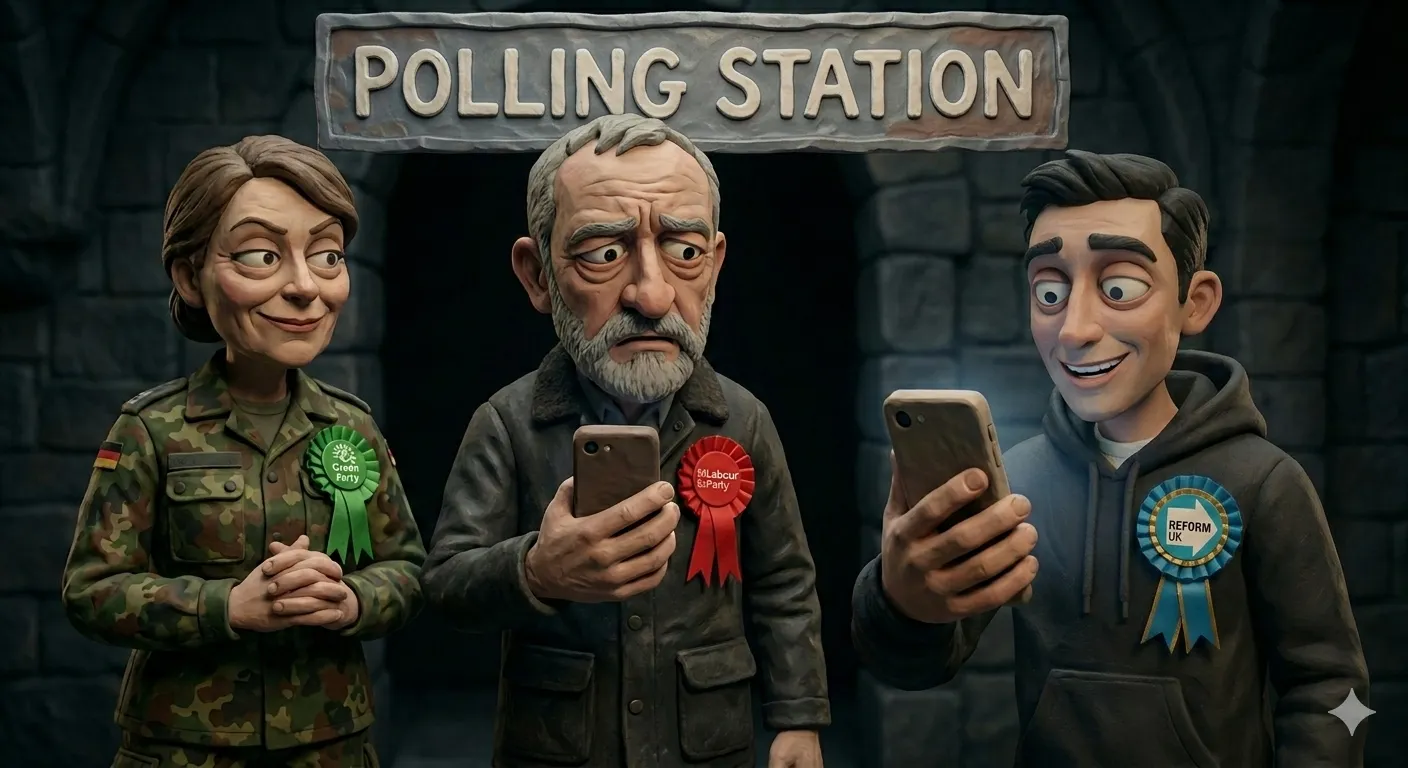
I sat as the rose between two thorns: a Reform UK representative to my left, a Green to my right. It made for great conversation and a certain pictorial irony — whoever would have thought that a Labour rosette might be capable of interpretation as centrist? Each of the other tellers rotated once during my stint, giving me the chance to speak with four people.
We are all so ordinary
The first Reform UK teller was a Cheshire-based retired businessperson whose son had recently closed his hospitality business. Conditions had become too tough, he explained — a handful of customers had gone under in the post-Christmas reckoning. He wants a better deal for small businesses.
His replacement was a 23-year-old IT support worker at a local NHS trust, someone who had benefited from an apprenticeship. He wants an end to mass immigration, supports the idea of an American-style ICE unit, and thinks net zero is nonsense. A few minutes of fact-led conversation made clear that this young man has been sold a pack of lies and is genuinely confused across all his talking points. That setting is no place to unpick any of it — but his reasoning reminded me of the ordinariness of similar conversations I’ve had over the past year with others who align with Reform UK.
Common among these people is the lack of any obvious racist or Islamophobic underpinning. In that sense, these people do not fit the caricature of the hate-filled racists who align with Reform UK, including the prominent Gorton and Denton by-election Reform UK campaigner who was suspended over 'racist social media posts.'
One thing stood out that leaves me deeply concerned. This young man knows his chances of getting onto the property ladder are slim, despite earning a decent salary and living in a relatively affordable area. He also knows that even if a purchase were possible, he’d be financially stretched in ways that make him uncomfortable. His definition of discomfort is missing out on beer; mine is having no beer and only the very occasional meal out. The gap matters less than the shared recognition: his life chances, like those of my grandchildren, are diminished. Solving that glaring inequality matters for all our futures.
The two Green tellers had travelled from Hertfordshire and were both former Labour members — bitter and bruised by the internal warfare that brought Keir Starmer and Blue Labour to power. “You can’t possibly support Labour Together after everything that’s happened!” one of them said. They’re not wrong. I’ve long felt that Labour Together collaborators and polluters, including McSweeney, Glasman, and Simons in particular, are a cancer on the party.
But once you move past the partisan talking points, the people I met share a common wish for a fairer society. One mentioned that her son — half Egyptian and working for the Met — finds his life “difficult.” She advises people to avoid marches and demonstrations in London. “There are so many of them. The police are getting exhausted,” she said.
The irony was neatly captured by one of the Reform tellers: “We all want the same thing at the end of the day — a better life for ourselves and our children.” I was reluctant to argue with that basic premise, though I did offer: “We likely do, but we disagree profoundly on how we get there — whatever ‘there’ is.”
A decent turnout and teller troubles
I was surprised by how many voters came through during my shift. Based on experience, I’d expected a slow, steady trickle. Instead, there was a consistent stream, with a notable surge between noon and 1.30 pm. Plenty of Black African and South Asian heritage voters came through, along with the occasional cluster of boastful Reform supporters dragging their entire families behind them. As an aside, the final turnout was almost identical to that of the 2024 General Election. The votes were not in the same place. Not by some distance.
The local polling station manager unilaterally decided that tellers should not attempt to collect voter data before people entered, which made things considerably harder, since gathering it afterwards is far more difficult. Worse still, my teller app struggled to keep pace with the flow, and I missed roughly 10 to 15 people across the three hours I was on duty.
Reform’s app is a winner compared to Labour’s offering
The Labour Party app is not built for speed. It assumes voters will have their polling cards with them, allowing entry via registration ID — but I saw only one card among at least 100 people I checked in. Without a registration number, the app requires both a postcode and a full name, which slows things down considerably. Reform UK’s app is far slicker: it works on name and predicted address alone, confirmed with the voter on the spot. I ended up borrowing names from the Reform tellers more than once.
In the quiet intervals, I got a closer look at the Reform app. It’s built on NationBuilder — a modern platform, and a significant step up from Labour’s patchwork of web tools operating under the Labour Hub banner. The Reform app is visually immediate and comprehensive: it streams Reform-specific news and commentary, much of which I’d never seen in the public domain, and serves equally well whether you’re an ordinary member or an activist. The eye appeal is instant; the functionality is genuinely useful. The only downside seems to be that in its present iteration, the app can fail where the network connection is poor. It only happened a few times but was clearly a source of frustration to the Reform UK user.
What, no Green app?
Here is the kicker. The Green tellers had no app and weren’t counting at all. So why were they there? Presence. Visibility. And that, it seems, was enough — certainly enough for the four physically disabled voters who arrived on mobility scooters, happily provided their details, and made their voting intentions fairly clear without ever stating them. If I had to guess: one each for Reform and Labour, two for the Greens. Anyone curious about that split might start by reading the Disability News Service’s investigation into Labour’s £5 billion disability benefit cuts — and asking why a party that once championed the most vulnerable is now being taken to task for abandoning them.
Final thoughts
As someone who has done teller duty in the past, I was not expecting much obvious partisanship among voters. Apart from the few blowhards mentioned above, most want to do their civic duty and move on with their lives, hoping that the party they support will not only win but also deliver on its campaign promise.
Predicting election results in the UK is a nightmare. The almost never-ending stream of polls all got the result wrong, and by some margin in all cases. I’ve always been told that our ‘get out the vote (GOTV)’ is an essential part of the campaign, allowing campaign managers to quickly deploy activists to places where people have not yet voted and may be persuadable. The election result indicates that in-person GOTV was pointless.
Why that was the case is beyond the scope of this story. However, one indication came when a voter showed me a photo of the floor behind her front door after a two-day absence. It was littered with campaign material. “I’m sick of it!” she exclaimed. Along with my fellow teller travellers, I apologised. What else could we do?